



Understanding the menstrual cycle also means getting to know yourself. Not only does it indicate the health of a woman's reproductive system and fertility, but also her general state of health. We'll take a look at what's going on to help you make sense of it, before we talk about the consequences for training in another article!

What is the menstrual cycle?
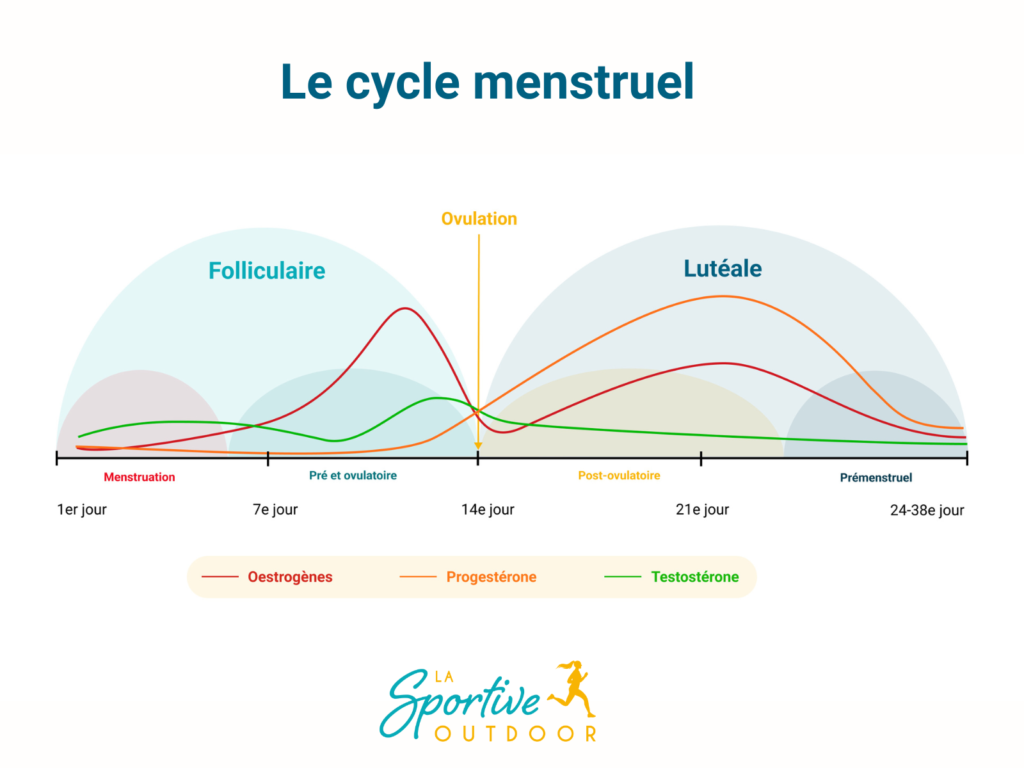
A menstrual cycle begins on the first day of menstruation. It is divided into 2 phases, the follicular and luteal phases, which are separated by ovulation:
- The follicular phase includes menstruation, followed by the “pre-ovulatory” phase. This is the phase of preparation of the ovum that will be released and potentially fertilized at the moment of ovulation.
- The luteal phase marks the end of the cycle. This phase prepares the uterus to receive the fertilized or unfertilized egg. If the egg is not fertilized, it will be eliminated. This is reflected in the bleeding known as menstruation.

Cycle time
The length of a cycle varies from woman to woman. A cycle is considered “normal” when it lasts between 24 and 38 days, with bleeding lasting between 3 and 8 days.
Some women have “long” cycles of around 38 days, while others have “short” cycles of around 24 days. Menstrual blood flow is defined as light, normal or abundant. This is specific to each woman.
Menstruation, a sign of good health!
Ovulation is beneficial to a woman’s health. It’s not just there to enable pregnancy. In particular, the menstrual cycle plays an important role in a woman’s bone health, the repercussions of which can be seen post-menopause.
Irregular or absent menstrual cycles and bleeding (amenorrhea) may indicate a hormonal imbalance or other health problems such as RED-S syndrome. In such cases, medical supervision is essential.
Take care of yourself by ensuring an adequate calorie intake: a regular menstrual cycle reflects a nourished and balanced body.
Age of onset
The first menstrual periods (known as menarche) appear on average around the age of 12 or 13. The regularization of cycles is not immediate, and may take several years.
Hormones of the menstrual cycle
Three hormones are involved in the functioning of the menstrual cycle and are therefore of particular interest to us:
- Estrogen, the hormone of the strong woman. They give you energy, motivation and power.
- Progesterone is the hormone that makes you more introspective, attentive and focused. It also has an antidepressant and neuroprotective effect.
- Testosterone is the power hormone. It’s the hormone that promotes strength, endurance and fatigue reduction.
How to spot ovulation?
The white discharge, called cervical mucus, changes. Mucus becomes more abundant, elastic, shiny, transparent and fluid.
The menstrual cycle – The 4 sub-phases
The menstrual cycle begins on the 1st day of menstruation and is divided into 4 sub-phases marked by hormonal fluctuations. It’s important to note that every woman’s experience is different, as each has her own fluctuations. It’s up to you to observe yourself and get to know yourself better!
- From the first day of menstruation, hormones are at their lowest. The various menstrual symptoms (pain, fatigue, etc.) are present and specific to each woman. During this period, it’s important to pay attention to your iron levels, due to blood loss.
- The pre-ovulatory phase corresponds roughly to the period between days 7 and 14 of the cycle. During this period, estrogen and testosterone levels rise. We’re therefore in a phase where our energy is at its highest. Our strength and endurance are enhanced during this period. Estrogens improve calcium retention, helping to maintain bone density. High estrogen levels increase ligament flexibility and contribute to healthy tendons and ligaments. Beware, however, as this flexibility can more easily lead to injuries and sprains. We’re generally in a very positive psychological state during this period.
- At the moment of ovulation, the levels of the various hormones fall. Then, during the post-ovulatory period of the luteal phase, between days 14 and 21 of the cycle, estrogen levels rise again, as do progesterone levels. This is a phase of calm and concentration, made possible by the increase in progesterone levels. It is progesterone that prepares the body for a possible pregnancy. Metabolism increases, which can lead to cravings in some women. This phase can be identified by an average 0.2°C rise in body temperature .
- The pre-menstrual phase is characterized by a drop in hormones and the onset of pre-menstrual symptoms, or even premenstrual syndrome (PMS) for some women.Psychological state can be negative during this period.
To understand your cycle, you can follow the evolution of various symptoms: temperature change, evolution of cervical mucus, cervical variations, mood changes, transit, pain…
Bibliography
- Dhanalakshmi K. et al. 2024 – Physiology, Menstrual Cycle – https://www.ncbi.nlm.nih.gov/books/NBK500020/
- https://www.yourperiod.ca/fr/normal-periods/menstrual-cycle-basics/
- https://www.elsan.care/fr/pathologie-et-traitement/glossaire-medical/gynecologie/cycle-m ,
- Ebook Menstrual cycle and sport by Juliana Anterro,
- Prado et al. 2021 – Menstrual Cycle, Psychological Responses, and Adherence to Physical Exercise: Viewpoint of a Possible Barrier https://www.frontiersin.org/journals/psychology/articles/10.3389/fpsyg.2021.525943/full
- Emilie RIMBERT – Train like a woman, not a man