


Relieving premenstrual syndrome (PMS) with phytotherapy

Menstrual disorders are unfortunately widespread among women of childbearing age. Still very taboo in our society, they can be particularly disabling for those who regularly suffer from premenstrual syndrome (PMS). Fortunately, Mother Nature is here to help! In this article, I'd like to share with you a few herbal remedies to help you cope. Hopefully, they'll help you if you're suffering from PMS!
Warning: this article offers some “natural” suggestions to help you cope with the premenstrual period. In no way does it exempt you from consulting your doctor or taking any prescribed treatments.
Premenstrual disorders & PMS: what are we talking about?
It’s a set of physical and psychological symptoms that occur in the period leading up to menstruation, and which can last through the first few days of menstruation. Here are the most common symptoms:
- abdominal cramps
- pelvic and lumbar pain
- swollen breasts, even painful congestion
- watery swelling of the rest of the body, with weight gain (1 to 3 kg depending on the woman): abdominal bloating, heavy legs, puffy face
- an acne flare-up
- transit disorders, the most common being constipation in the premenstrual period followed by diarrhea during menstruation
- deep physical and psychological fatigue
- sleep disorders (mainly nocturnal insomnia)
- behavioral disorders: irritability, aggressiveness, emotional instability, libido problems, compulsive eating (especially sugar!)
If you are affected by several of these symptoms, occurring for more than three cycles, you are subject to PMS (premenstrual syndrome). What a sweet acronym for so much suffering… Read on, and I hope you’ll find at least one of the suggestions helpful.

But where do these disorders come from?
Without going into too much detail, your menstrual cycles are governed by two sex hormones: estrogen and progesterone.
In the first half of the cycle, estrogen dominates (until ovulation). Then progesterone takes over (to prepare for possible implantation). If fertilization does not occur, progesterone drops from day 20 onwards (for an average 28-day cycle). This is where the trouble starts, since this hormone (somewhat by the principle of communicating vessels) counterbalances the effects of estrogen, as described in the previous paragraph!
PMS is therefore a sign of relative hyperoestrogenism, due to a lack of progesterone. So it’s understandable that we’ll be turning to so-called “progesterone-like” plants (which act like progesterone) for relief.
Comment soutenir La Sportive Outdoor?
L'une des façons de nous soutenir est de faire vos achats via nos sites partenaires.
L'idée n'est évidemment pas de vous pousser à la consommation: n'achetez que ce dont vous avez besoin mais, lorsque vous le faites, passer par nos liens nous aide car nous touchons ainsi une petite commission sans aucun coût supplémentaire pour vous.
Vous pouvez par exemple en ajouter certains en favoris pour vos prochains achats. Pensez à accepter les cookies de nos partenaires dès l’arrivée sur leur site.
- i-Run: jusqu'à -50% pour les Running Weeks
- Ekosport: -20% extra sur les nouveautés rando et bivouac
- Intersport: des offres sur la randonnée (notamment)
- Muule: 15% de promo avec le code VIP15
- Decathlon: pas mal de bons plans
- Lyophilisé&Co: lyophilisés, nutrition sportive et matos de bivouac
Pour plus de façons de nous soutenir, c'est ici.

Predisposing factors
Pay attention to your lifestyle ! Certain factors can accentuate an already PMS-prone environment:
- be careful with red meats, deli meats, cheeses and sugars: they can tend to increase the inflammatory ground.
- engage in regular physical activity (if you’re reading this article, you certainly do!).
- stop smoking or severely limit your consumption
- also limit your consumption of coffee and alcohol
- get a good night’s sleep, or have someone accompany you if you don’t
- manage your stress on a daily basis (it’s not a question of eliminating it – impossible! – but of coping well with it)
Herbal solutions
Phytotherapy covers a range of plant-based solutions, with different techniques: herbal medicine, aromatherapy, gemmotherapy, Chinese phytotherapy, …. Let’s take a look at some common remedies:
- Chaste tree (Vitex agnus-castus): it’s progesterone-like, so it counteracts the effects of estrogen overload. I’ve found it to be highly effective with many women! But beware: it can be anaphrodisiac 😉 Choose dried plant capsules, a fluid extract or a mother tincture. A priori, it does not interfere with oral contraceptives.
- Yarrow (Achillea millefolium): also progesterone-like, it is anti-inflammatory, spasmolytic (reduces spasms) and emmenagogue (triggers menstruation). Interestingly for those who suffer from menstrual disorders, it is also a digestive plant. It can be used as an herbal tea or fluid extract, and is particularly useful for women prone to uterine and intestinal spasms.
- Alchemilla (Alchemilla vulgaris): also a progesterone-like plant, it is anti-hemorrhagic and therefore very useful for women with heavy periods and leucorrhoea (white discharge). It is best taken in the second half of the cycle, always in the form of a fluid extract or dry plant capsules.
- Mugwort(Artemisia vulgaris) is an emmenagogue (promotes menstruation), spasmolytic and menstrual-regulating plant. I find it very effective for girls and young women. It’s an uncommon plant in the French pharmacopoeia, but I do find it in fluid extract form, to be taken at a rate of 1 mL per day outside menstruation, and rather 2 to 3 mL (depending on sensitivity) a week before menstruation, until symptoms subside.
- Raspberry (Rubus idaeus) is traditionally used in the form of gemmotherapy (a branch of phytotherapy which uses the buds of the plant, macerated in glycerine); it is a formidable hormone regulator. It’s a very gentle but slow approach, suitable for the most sensitive and reactive women. The drops are to be taken daily, 3 weeks out of 4 (stopping during menstruation if possible).

Aromatherapy solutions
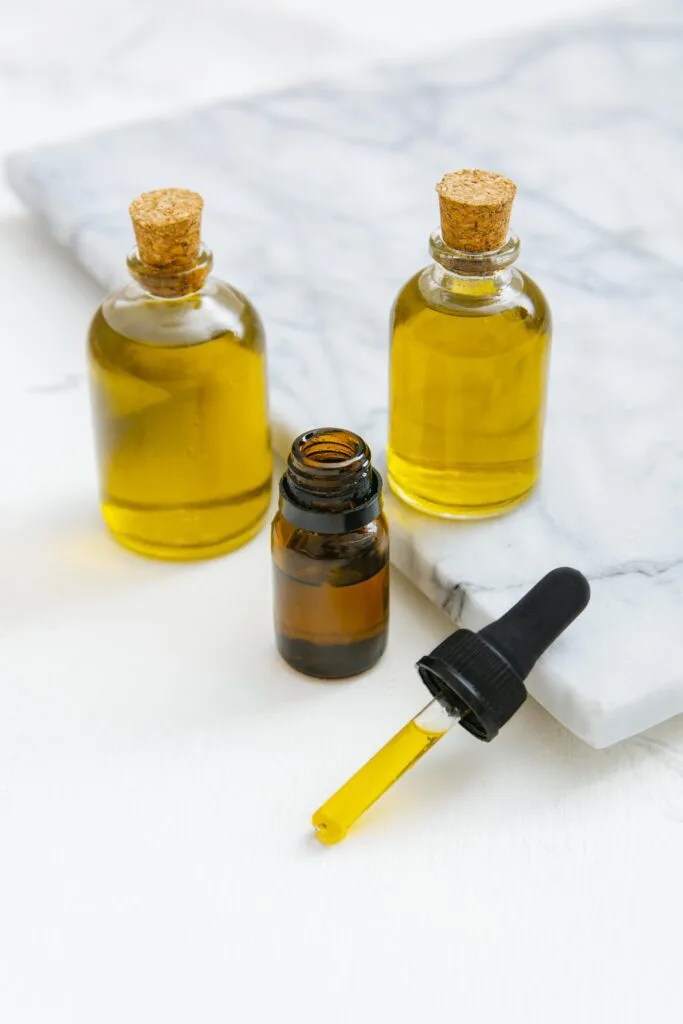
In aromatherapy, essential oils are used externally (on the skin and by inhalation), mainly to relieve symptoms, but also as a background treatment. Here are a few reference oils for PMS:
- Clary sage (Salvia sclarea): estrogen-like, it is especially useful for painful periods. Use diluted (2 drops diluted in 2 drops of a vegetable oil such as sweet almond, apricot kernel, jojoba… or olive oil if you have nothing else!), massaged into the lower abdomen during menstruation. Warning: it is not recommended for people with a history of hormone-dependent cancers.
- Tarragon (Artemisia dracunculus) or Tropical basil (Ocinum basilicum var. basilicum ): these two essential oils are very similar. They are strongly antispasmodic and will therefore be very useful in pain management, why not in combination with clary sage. If you also suffer from digestive problems, they’re definitely for you! Massage your lower abdomen with one of these two oils, always diluted (about 2 drops for 4 to 5 drops of vegetable oil), several times a day.
- Ylang-ylang (Cananga odorata): if you’re not familiar with this essential oil, it’s a must-try! Its island fragrance will have you traveling the world without leaving home! It has antispasmodic properties, relaxes the nervous system, is an aphrodisiac and encourages you to let go. It’s ideal if you’re experiencing psychological difficulties with PMS. You can use it straight from the bottle, or massage it (2-3 drops in 5 drops of vegetable oil) on the solar plexus to release tension, or on the lower abdomen.
Be careful!
Always check with a trained therapist that these plants are compatible with any treatment or pathology you may be suffering from. Avoid all these plants in the event of pregnancy, breast-feeding or suspicion of pregnancy.
A natural treatment lasting several months
Be persistent, as the effects of herbal medicine often take longer to be felt than those of allopathic medicine. Depending on the woman, you’ll need to continue treatment for 1 to 3 months before you start to feel the benefits.
If the plant or plants you’re using don’t work, don’t give up and try another. Every day in my consultations, I observe surprising results, with plant “A” being very effective for some of my consultants, but not at all for others; whereas plant “B” will be just right for these other people. We’re all different!
So here are a few tips that I hope will help you live better with your premenstrual problems, thanks to plants. Don’t hesitate to let us know if these tips have helped you, or if you have other ideas to share!
Bibliography
- Secrets of a herbalist. Marie-Antoinette Mulot, éditions du Dauphin, 2015
- Dictionary of medicinal and poisonous plants of France. Paul Fournier, éditions Omnibus, 2010
- Book of good herbs. Pierre Lieutaghi, Actes Sud, 1999
- Précis de phytothérapie: Essai de thérapeutique par les plantes françaises. Henri Leclerc, Masson et Cie Editeurs, 1935
- La phytothérapie: Se soigner par les plantes. Docteur Jean Valnet, Hachette, 1968
- La santé à la pharmacie du Bon Dieu. Maria Trében, Ennsthaler, 2000
- En bonne santé avec les plantes des Vosges et d’ailleurs, Christiane and Elisabeth Busser, La Nuée Bleue, 2009
- Aromatherapy for caregivers, Anne-Laure Jaffrelo, Dunod, 2020
- Femme Essentielle, Dr. Aude Maillard, Tana, 2019
- L’alimentation ou la troisième médecine, Jean Seignalet, Editions du Rocher, 2012 (5th edition)