

The annual cut: what are the benefits?

As the months go by, the sporting year puts the body under constant pressure. Taking an annual break can therefore be very beneficial: I explain why in this article.

Why make an annual cut?
Endurance sports, such as trail running, give the body little respite. Training hard all year round means exerting a progressive physical strain to accustom your body to assimilating a training load in line with your abilities.
The repetition of efforts leads to an accumulation of micro-traumas linked to the mechanical load, which eventually causes more or less marked physical fatigue. No structure is spared: muscles, tendons, joints and bones.
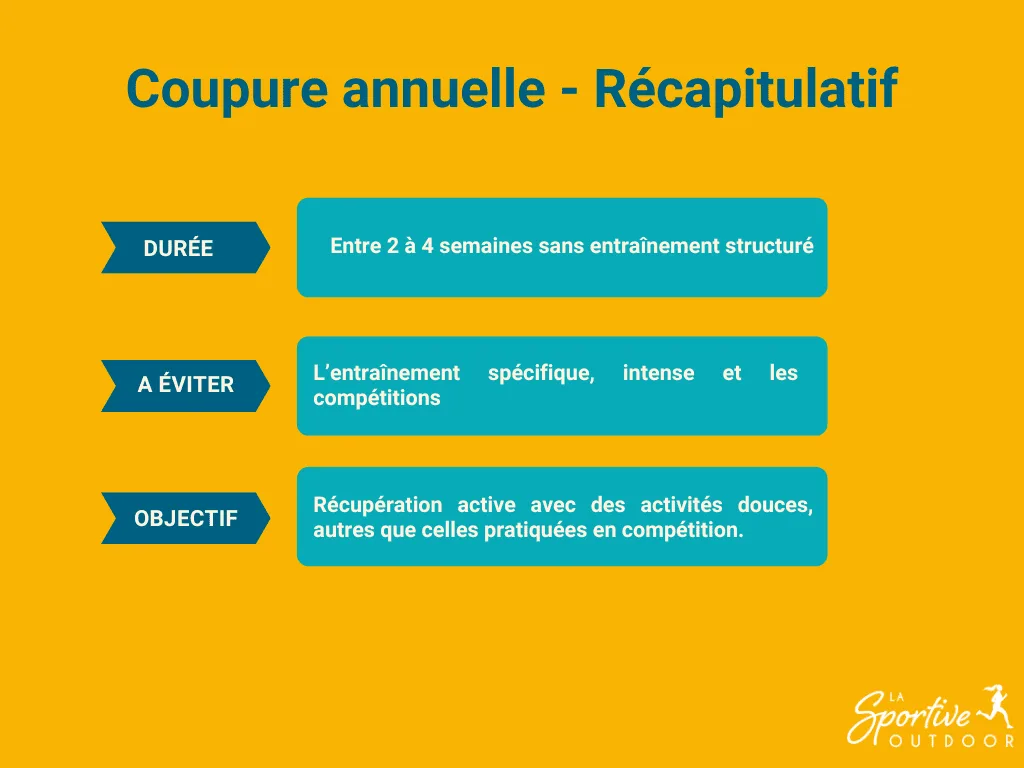
Hence the crucial importance of a well thought-out annual break, to allow body and mind to regenerate.

Physical benefits
Muscle and joint regeneration
Running, in general, imposes aheavy mechanical load. Downhill runs, long distances and changes in terrain put a strain on muscles, tendons, ligaments and joints. With each stride, the body absorbs impact forces up to 2 to 3 times the runner’s body weight. This has repercussions on musculoskeletal structures.
This mechanical stress causes micro-injuries that accumulate. Often without immediate pain, but eventually weakening the tissues if not repaired. Without sufficient rest, this can lead to chronic pathologies (tendonitis, periostitis or overload syndromes).
The annual cut allows the body to repair in depth and relaunch tissue repair processes.
Comment soutenir La Sportive Outdoor?
L'une des façons de nous soutenir est de faire vos achats via nos sites partenaires.
L'idée n'est évidemment pas de vous pousser à la consommation: n'achetez que ce dont vous avez besoin mais, lorsque vous le faites, passer par nos liens nous aide car nous touchons ainsi une petite commission sans aucun coût supplémentaire pour vous.
Vous pouvez par exemple en ajouter certains en favoris pour vos prochains achats. Pensez à accepter les cookies de nos partenaires dès l’arrivée sur leur site.
- i-Run: jusqu'à -50% pour les Running Weeks
- Ekosport: -20% extra sur les nouveautés rando et bivouac
- Intersport: des offres sur la randonnée (notamment)
- Muule: 15% de promo avec le code VIP15
- Decathlon: pas mal de bons plans
- Lyophilisé&Co: lyophilisés, nutrition sportive et matos de bivouac
Pour plus de façons de nous soutenir, c'est ici.
Preventing overtraining
Overtraining does not always result in injury. It can be nervous, hormonal or even
When overloaded without a rest phase, this system becomes less efficient, resulting in a constant feeling of fatigue, reduced motivation, poorer sleep quality and stagnant or declining performance.
A break helps to reset the central nervous system, to regain freshness.
Improved basal metabolic rate
An annual break helps reduce physiological stress levels, promoting better energy management, more efficient recovery from training, improved muscle rebuilding and an overall hormonal rebalancing essential for long-term health and performance.
The body needs to rest to assimilate the work done before it can be stressed again during a demanding session.

Mental benefits
Training and competition require a long-term commitment to progress, whatever your level. This commitment can lead to mental fatigue. A break allows you to relieve the pressure and recharge your mind.
Rediscovering pleasure
When you train all year round, between goals, competitions and plans to stick to, running can gradually lose its fun aspect. What started out as a passion sometimes becomes a routine, even a constraint. The pleasure of running can fade under the pressure of performance.
Taking a break for a few weeks, with no specific objectives or constraints, allows you to clear your mind and body. Gradually, the desire to run returns naturally. The desire to put the shoes back on and rediscover the sensations returns.
Step back and reflect
The break is an ideal time to take stock. It’s an opportunity to take stock of the past season: identify what went well, what can be improved, and understand your strengths and areas for improvement.
This period of hindsight allows you to think about future goals. Think about what you want to do next season: aim for a new record, discover a new discipline, take part in a legendary race, or simply continue to progress with pleasure.

Relational and personal benefits
Between training hours, travel to competitions and recovery, it can become very time-consuming. Sometimes forgetting the other important aspects of life: family, friends, non-sporting hobbies…
A break allows you to rebalance your personal life, take full advantage of the people around you, and rediscover other interests that are often put aside.
Finding a freer rhythm is essential for maintaining a balanced lifestyle, avoiding saturation, and maintaining a sporting practice that remains compatible with a personal and professional life.
Conclusion