

Test the Brompton G-Line – The gravel version of the famous Brompton

I tested the G-line folding bike from the famous Brompton brand, a versatile bike designed to be used in both city and gravel mode. Here's my full review after taking it out on a variety of trails!
My summary
What I liked
- Easy to fold and unfold
- Stable, well-balanced, comfortable bike
- At ease on all types of trails
- Small footprint
- Convenient for taking the train
What I liked less
- Heavy to carry
- Bigger footprint than the brand’s iconic bikes
Test video summary
How can Brompton’s G-Line be used?
Here’s a question I find a little hard to answer, since the G-Line is such a compromise between several worlds. Compromise means versatility, but also… Renunciation! Indeed, the G-Line stands out for its comfort and versatility for riding on just about any terrain, even with a bit of slope, but loses practicality once folded compared to the brand’s more urban iconic models, due to its weight and bulk, while remaining quite different from a “real” gravel bike.
All in all, I’d recommend the G-Line:
- to bikers using unpaved paths on their route
- for people who only have room to store a folding bike at home, and who have a mixed usage pattern, both urban on weekdays and nature outings or bikepacking on weekends or vacations.

Features
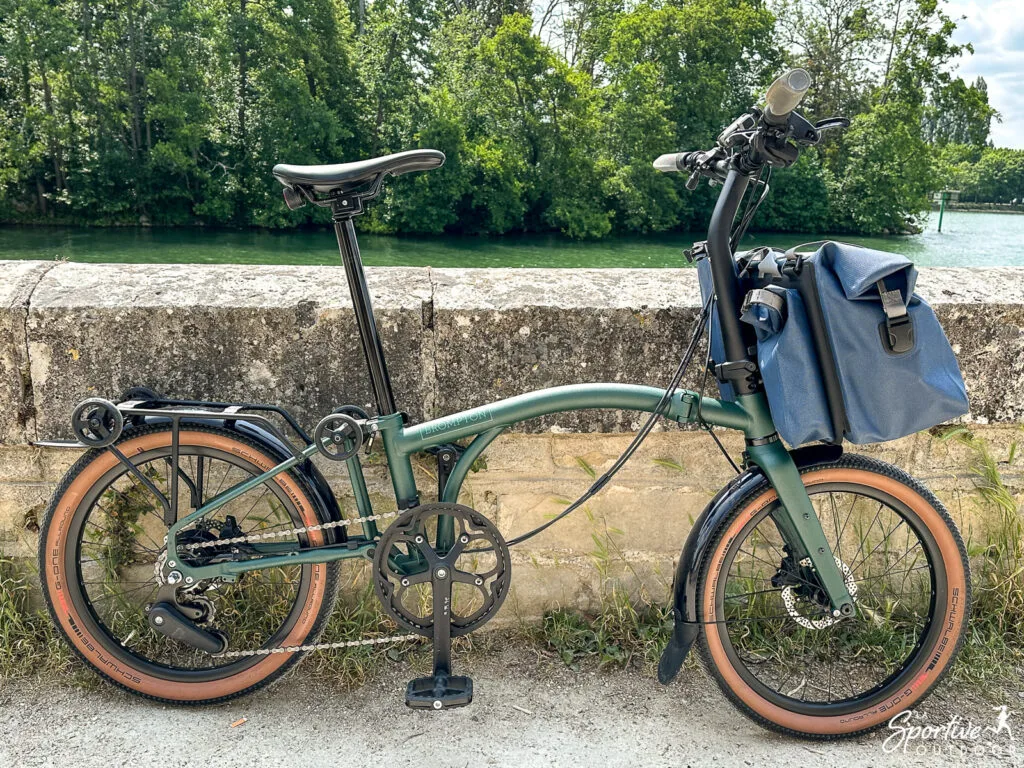
- Dimensions: 72 cm (D), 67 cm (H), 41 cm (W)
- Weight: I weighed it at 15kg (with luggage rack and mudguards).
- 8 speeds
- Sizes available: S, M and L
- Price: €3,079 (version with luggage rack)
The Brompton brand
Brompton is an iconic British brand specializing in folding bikes. Founded in 1976 by engineer Andrew Ritchie in a small London workshop, it is renowned for its compact design, craftsmanship and reliability. Each bike is designed to be compact, with an ingenious design that facilitates multimodal travel and storage.
Our full Brompton G-Line test
Test context
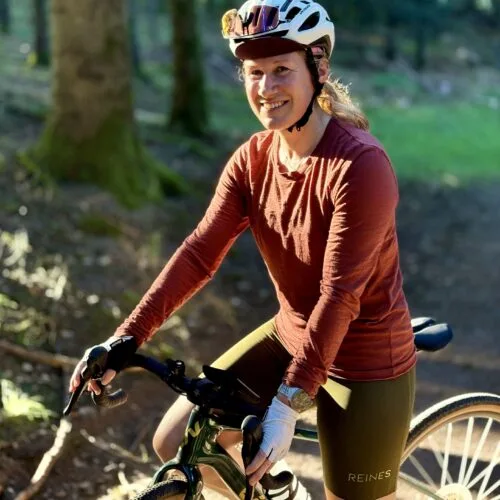
I had the Brompton G-Line “muscular” version (it also exists as an e-bike) on trial for 5 days in Paris and rode it for around 90km.
I used it on a number of trips around town, but also spent a day with it in the Forêt de Fontainebleau, just to get on the train and, of course, to test it on different terrains. I put it through its paces to provide you with the most relevant test possible!

Design
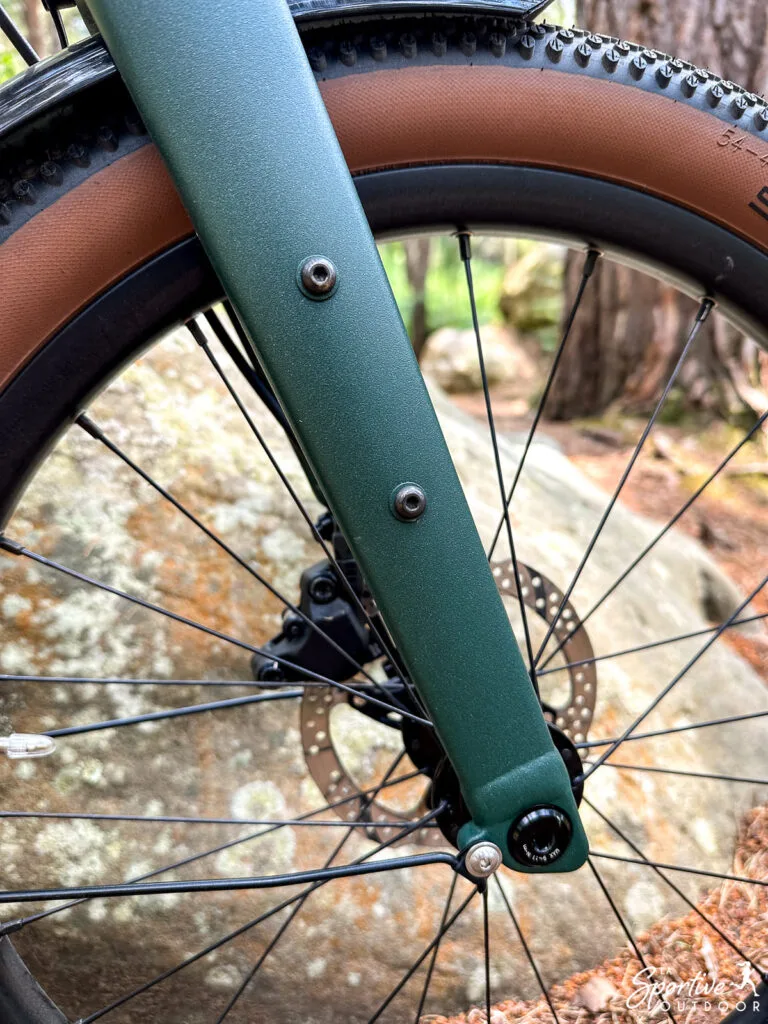
The G-Line’s design is very similar to other Bromptons (it looks pretty much the same), with a steel frame featuring larger-diameter tubes and an aluminum fork. The pedals are also a little wider.
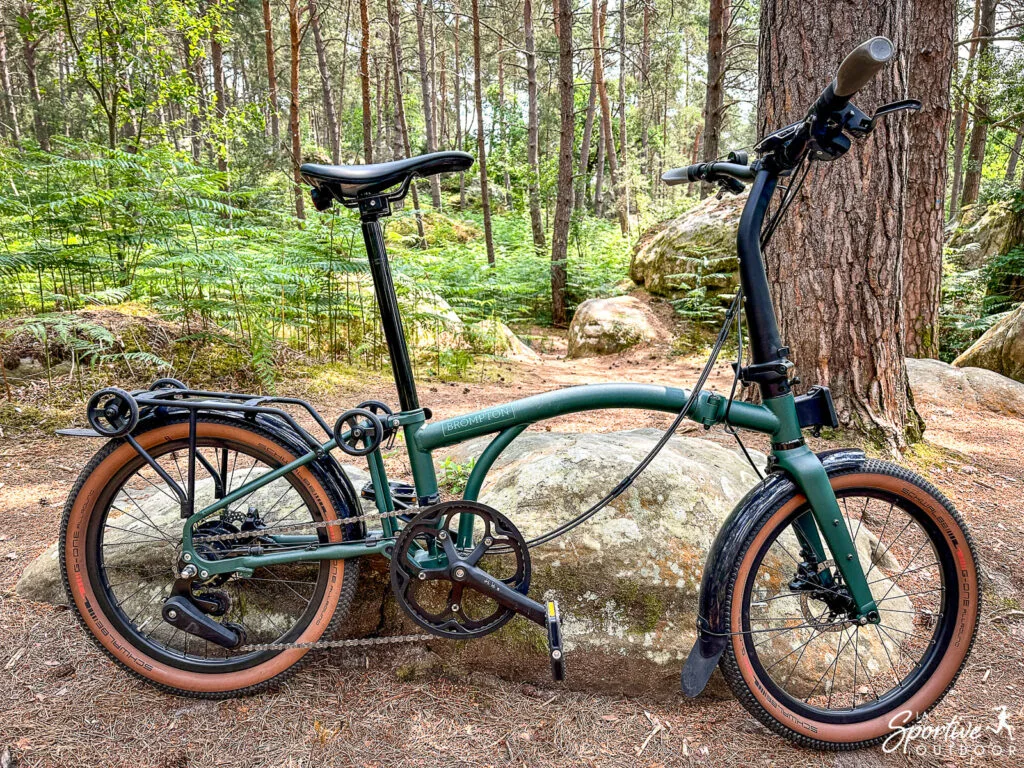
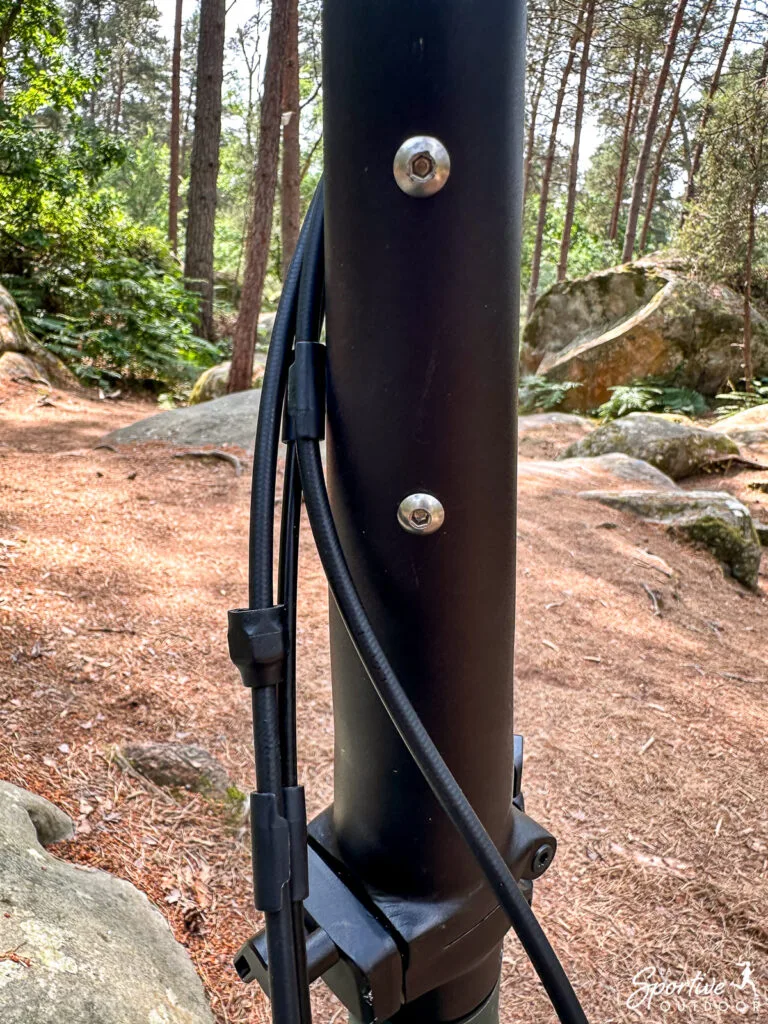
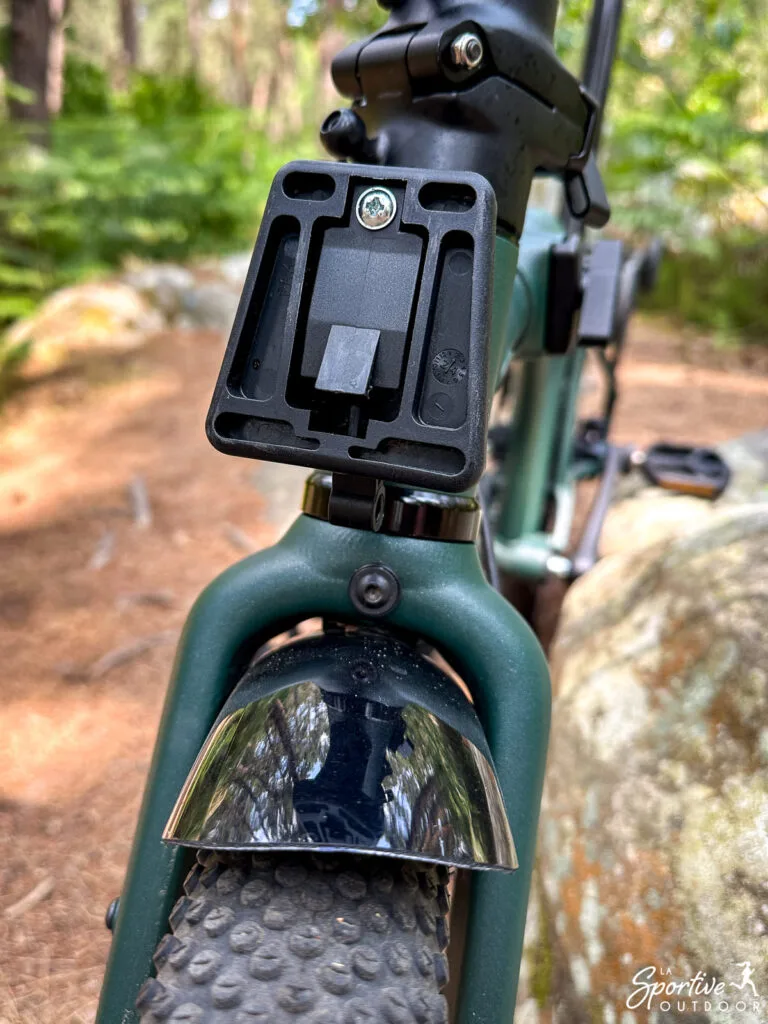
The bike is fitted with a number of eyelets: two on the head tube (useful for attaching a bottle cage, for example) and two on the right-hand side of the fork.
Tires
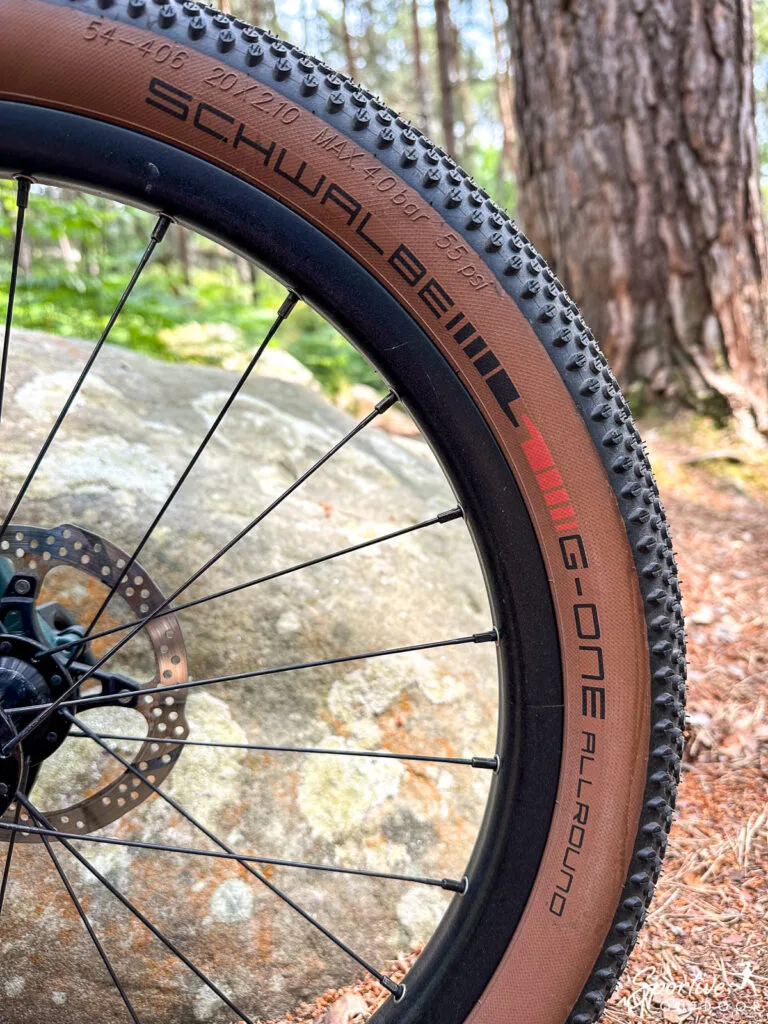
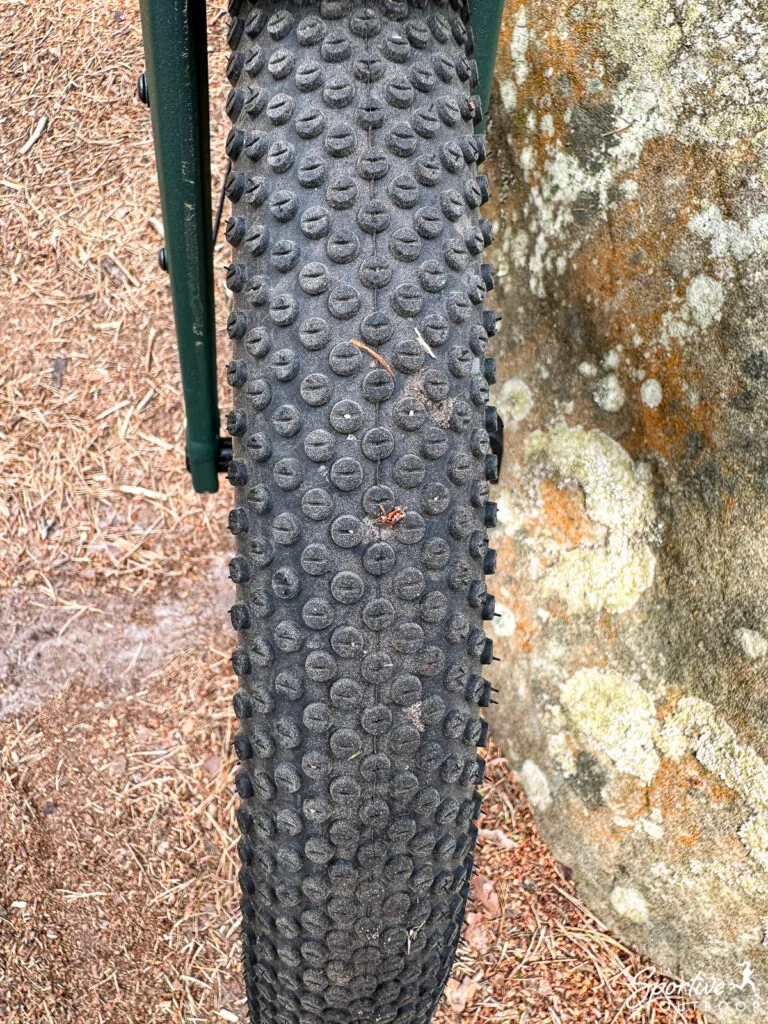
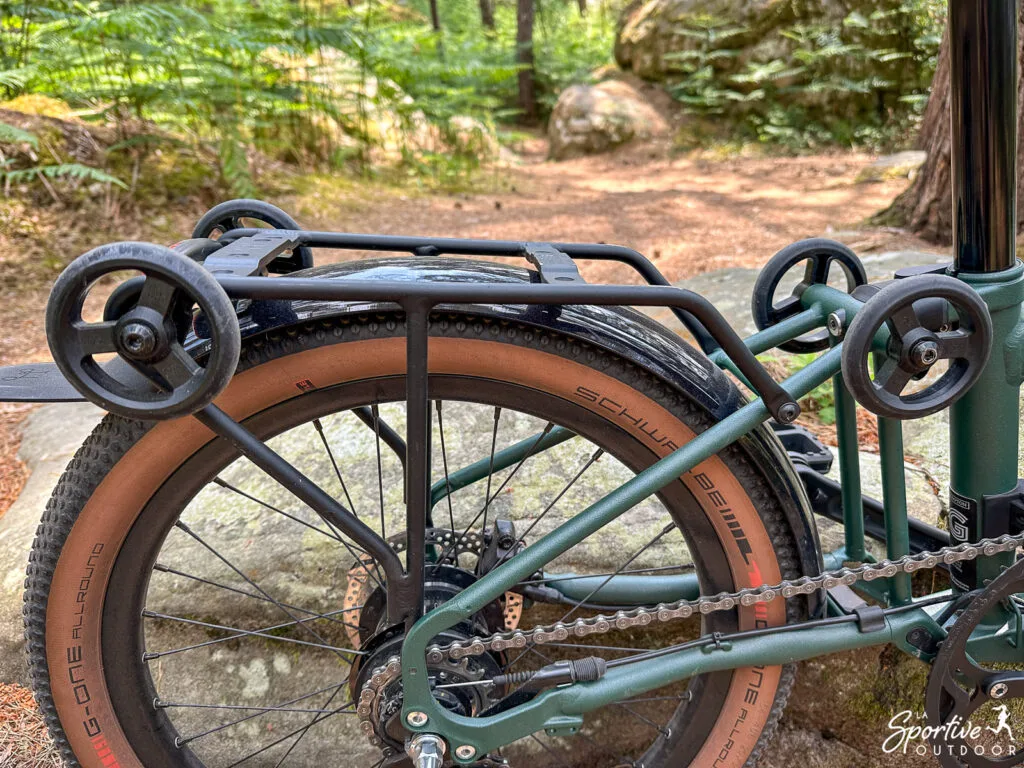
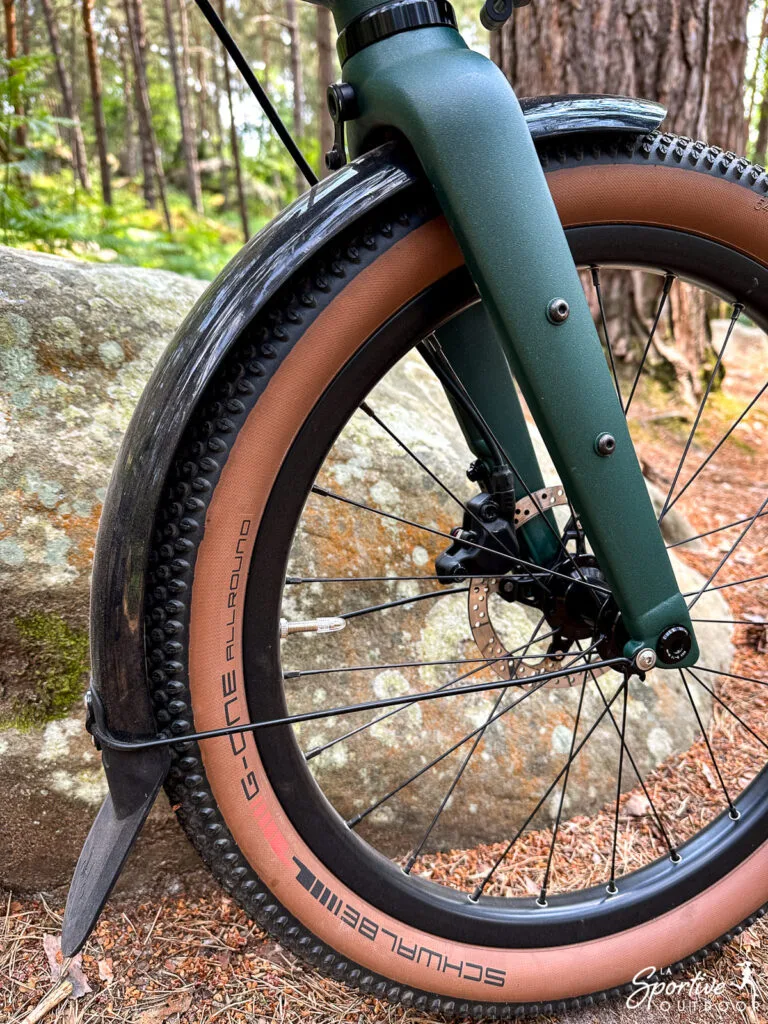
One of the big differences between the G-Line and other Bromptons are the 20-inch tires (as opposed to 16), fitted with 54mm Schwalbe G-One Allround tires (tubeless ready). These are well-compacted tires, suitable for gravel use.
I was very pleased with them, on the varied terrain I encountered in the Forêt de Fontainebleau and in Paris: roads, cobblestones, wide forest paths, more playful single-tracks, paths with a few stones and roots, sandy soils, wet roads, good little slopes… The grip was perfect!
I always felt good, even in the more technical sections (well, not mountain biking either, that’s not the point!) I just didn’t test in the mud.
Transmission
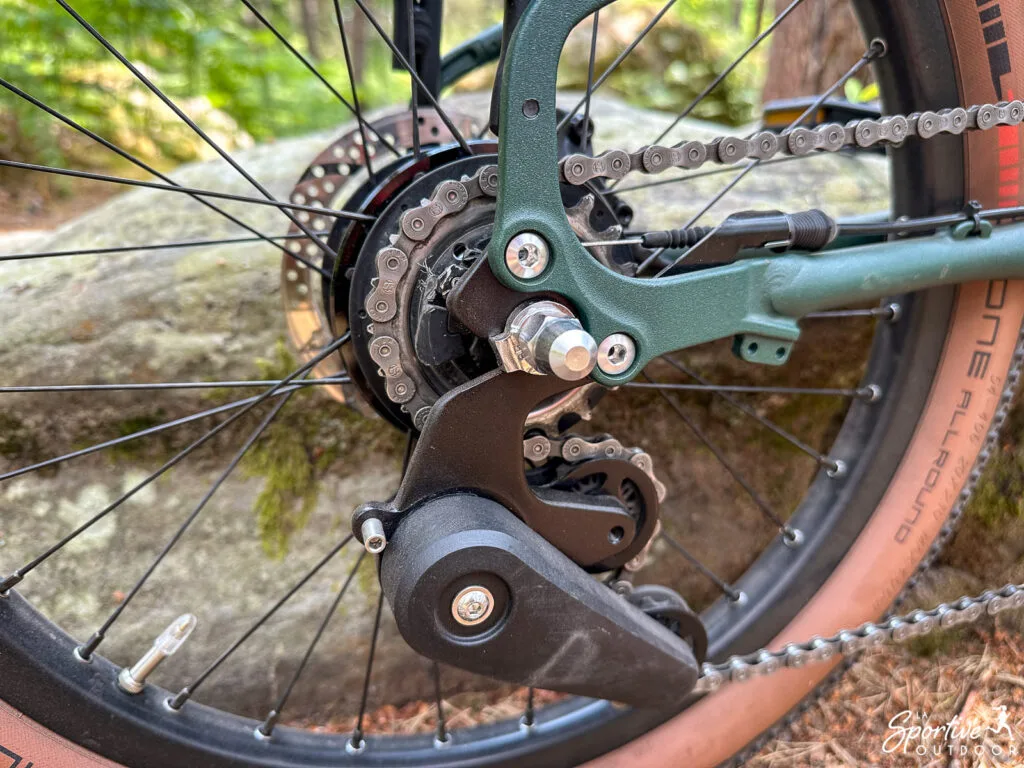
The G-Line is equipped with Shimano Alfine 8-speed hubs, which I found pleasant to use. Gear shifting was quite fluid, and I was even surprised to find myself able to climb some nice little inclines, although of course this isn’t going to be a bike for climbing mountain passes!
Another nice touch is that you can shift gears while stationary. Handy for easy restarting at red lights when you’ve forgotten to anticipate…

Brakes
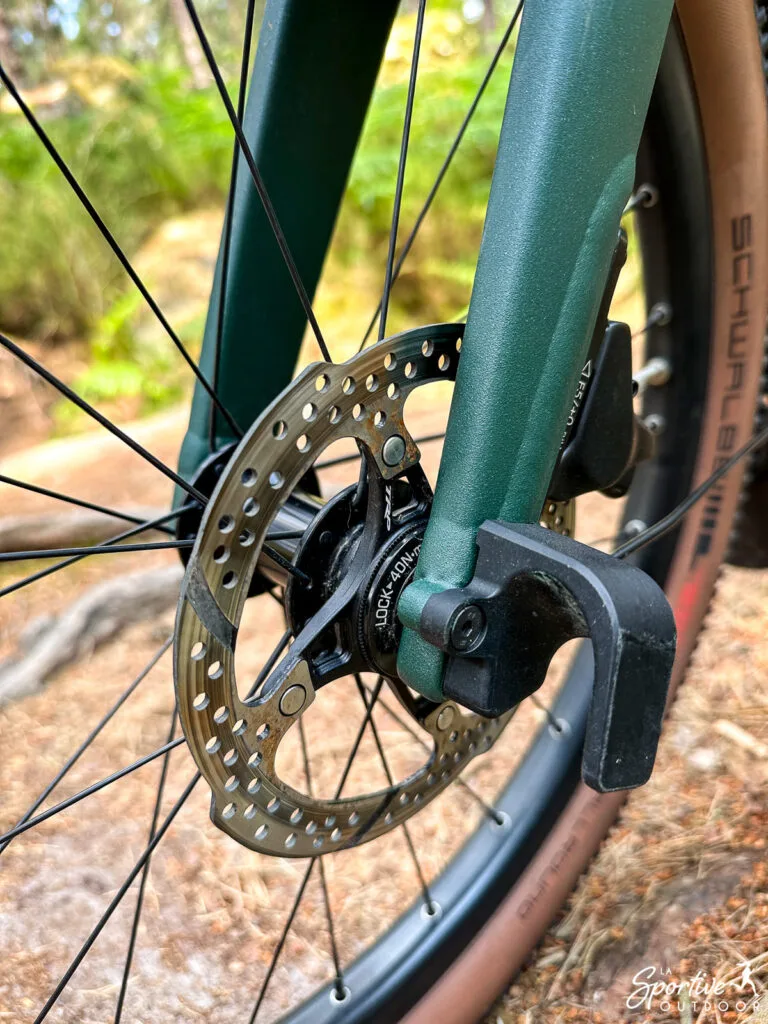
The G-line is equipped with hydraulic disc brakes which are super efficient… I even made an emergency stop in the streets of Paris and I think they saved me from a crash… Well, I could have done without them, but at least I’ve tested them!
Saddle
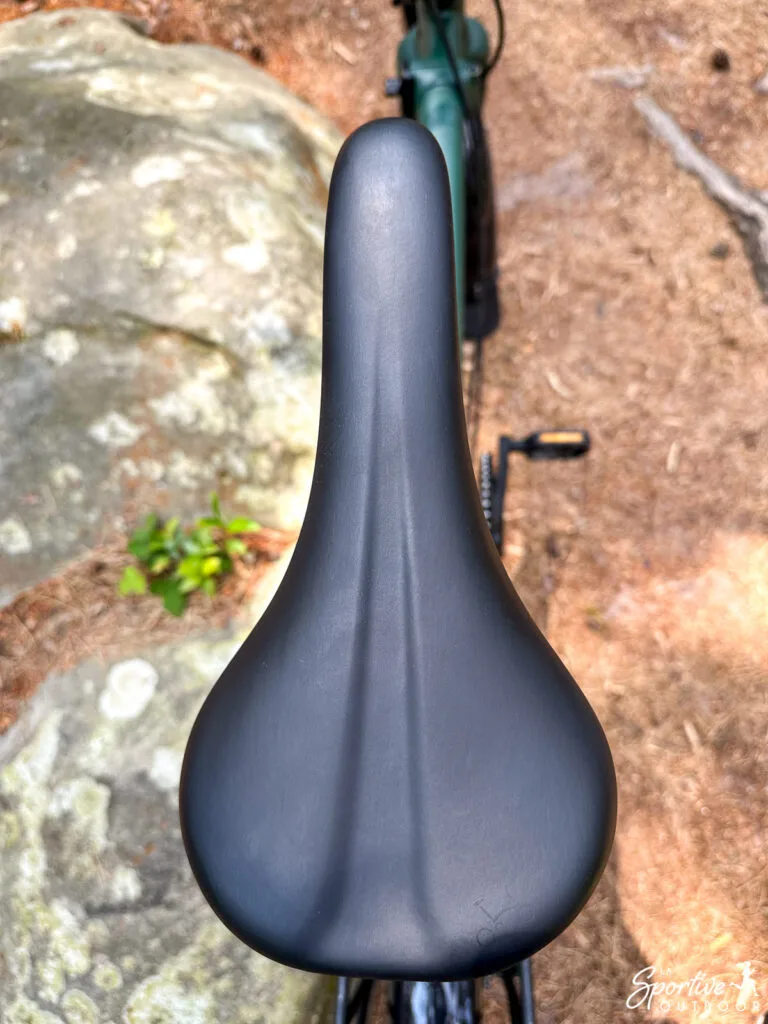
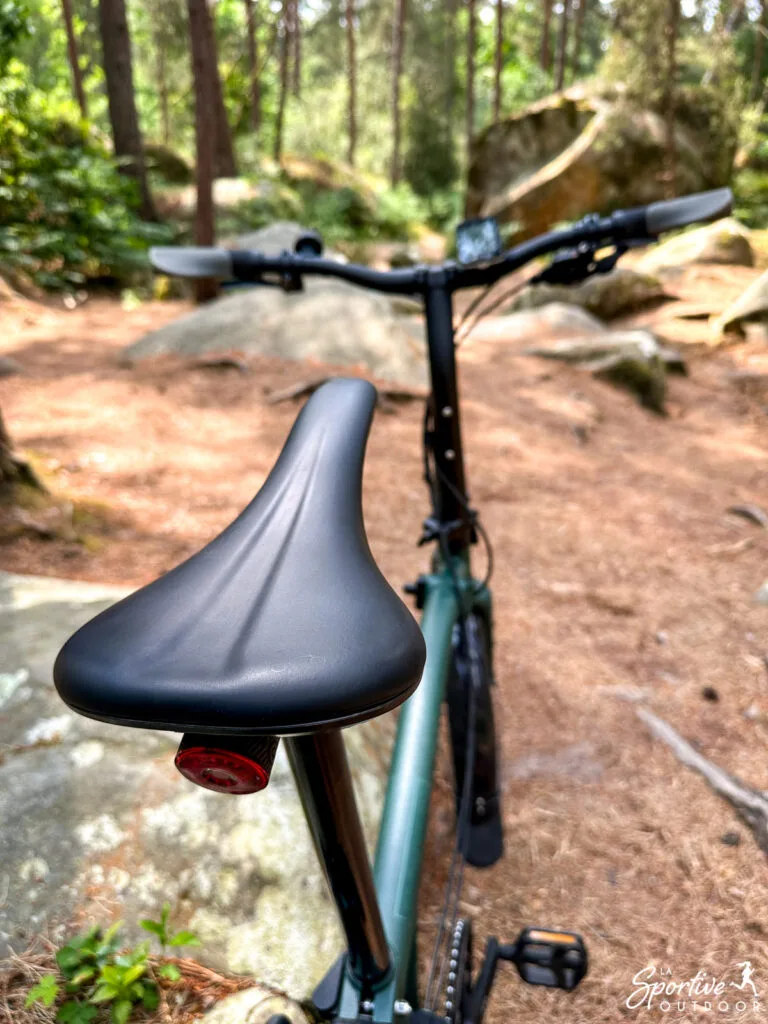
I didn ‘t find the saddle comfortable at all. I have to say that I could tell just by looking at it: this type of saddle is generally pretty good for men, but less so for women. Fortunately, saddles can be changed 😉
Folding and unfolding
Folding and unfolding the bike is the same as with “classic” Bromptons, and really efficient.
I’d never ridden a Brompton before, and admittedly it took me a while to get the hang of it, but after that it was quick and easy (I didn’t reach the 20 seconds claimed by the brand, but I only had the bike for a few days, so I’m sure I would have reached it after a bit more practice ;). ).
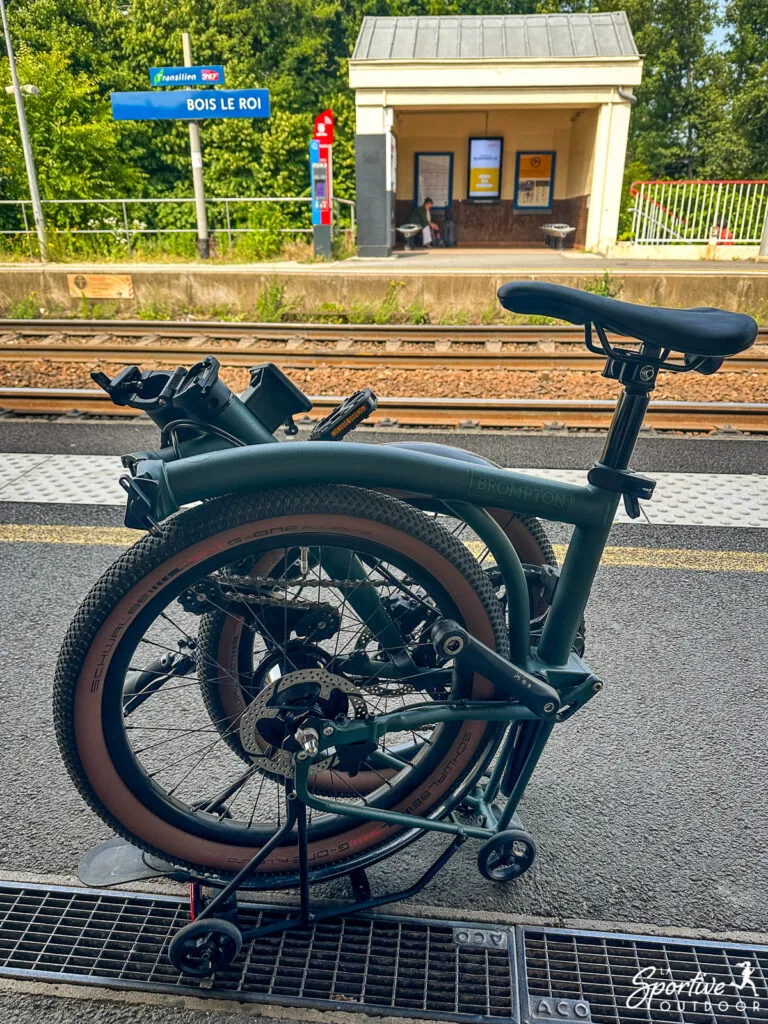
It is a 5-step process:
- A small lever at the rear is pressed while lifting the bike, to retract the rear wheel and place the bike on its rack.
- Separate the frame in two by unscrewing a wing nut, then tilt the front wheel against the rear wheel, locking it with a small hook.
- Folding handlebars
- Unclip the left pedal to stow it on the fork (to avoid banging into it during transport and to make it more compact).
- Lower the saddle to lock it in place and make it more compact
Note that you can simply do the first step to retract the rear wheel and place the bike on the luggage rack, which acts as a kickstand 😉
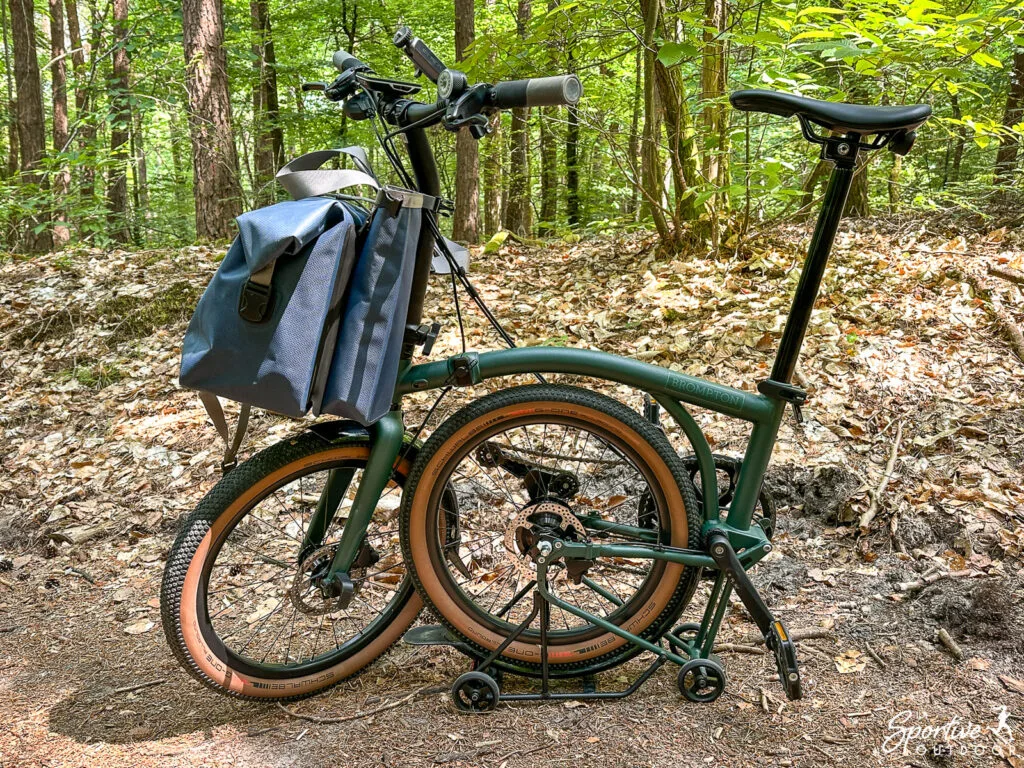
To unfold it, repeat the steps in reverse order, and off you go! The only inconvenience is that you have to readjust the saddle each time. It would have been nice to have some markers so you don’t have to fumble every time you use it.
Rolling sensations
Frankly, this little bike blew me away. With its distinctive design and small wheels (compared to a “classic” bike), I wasn’t sure what to expect and really enjoyed riding it on the trails.
I found it very maneuverable and dynamic despite its substantial weight, stable despite its small size, with very effective braking and tires that go just about anywhere… It’s great fun on a gravel outing!
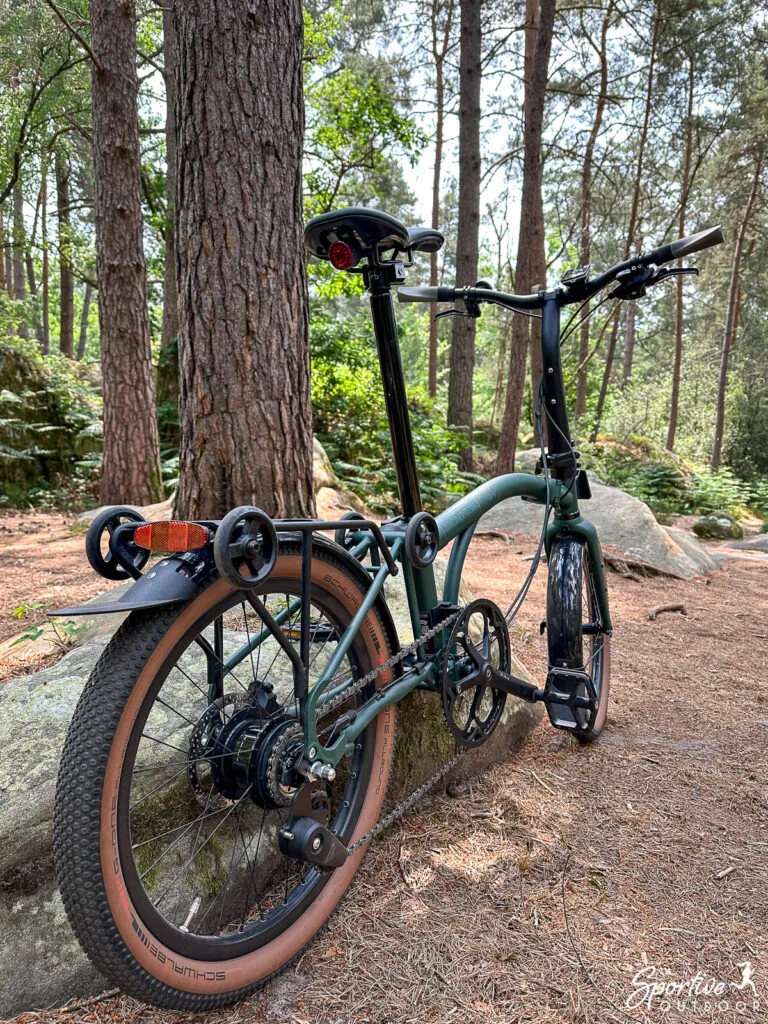
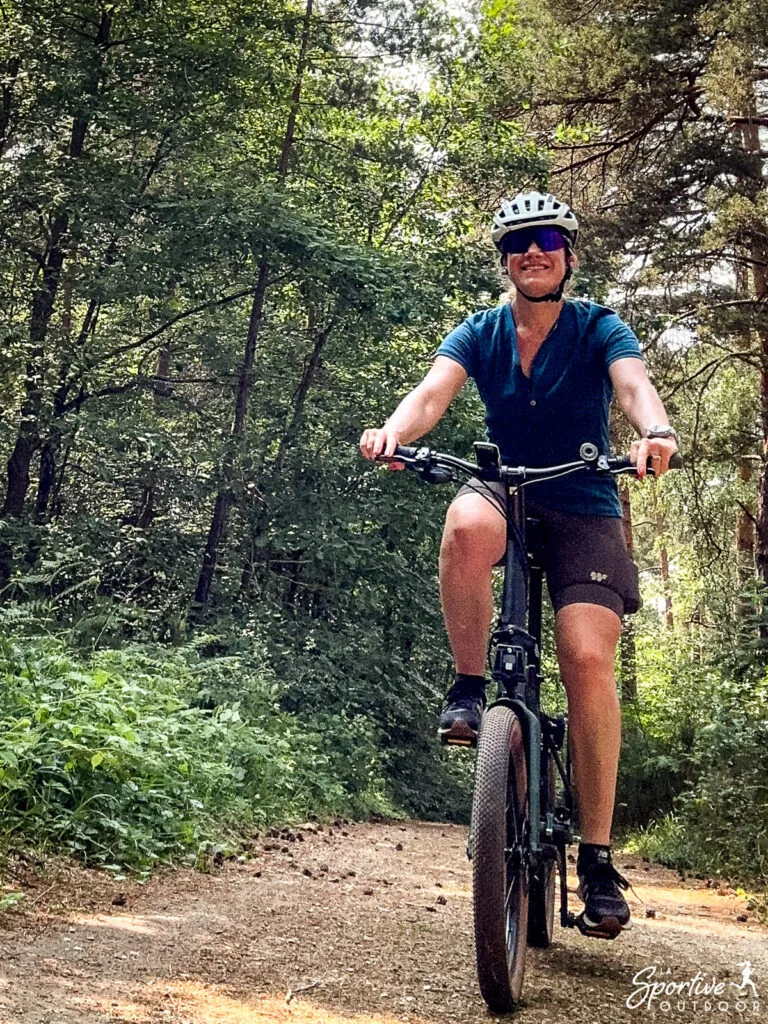
Comfort-wise, you’re pretty well set up overall (although I wouldn’t have ridden too many kilometers in a row with this saddle!), with a fairly upright position. The handlebars are quite wide, which perturbed me a little at first, but in the end it was pleasant and certainly good for stability on varied terrain.
Of course, you shouldn’t compare it to a “real” gravel bike: the G-Line remains a compromise between gravel and urban cycling. There’s really no need to look for performance here, as the upright position is not the most efficient, and developments remain limited. We won’t be taking it on too steep a terrain either.
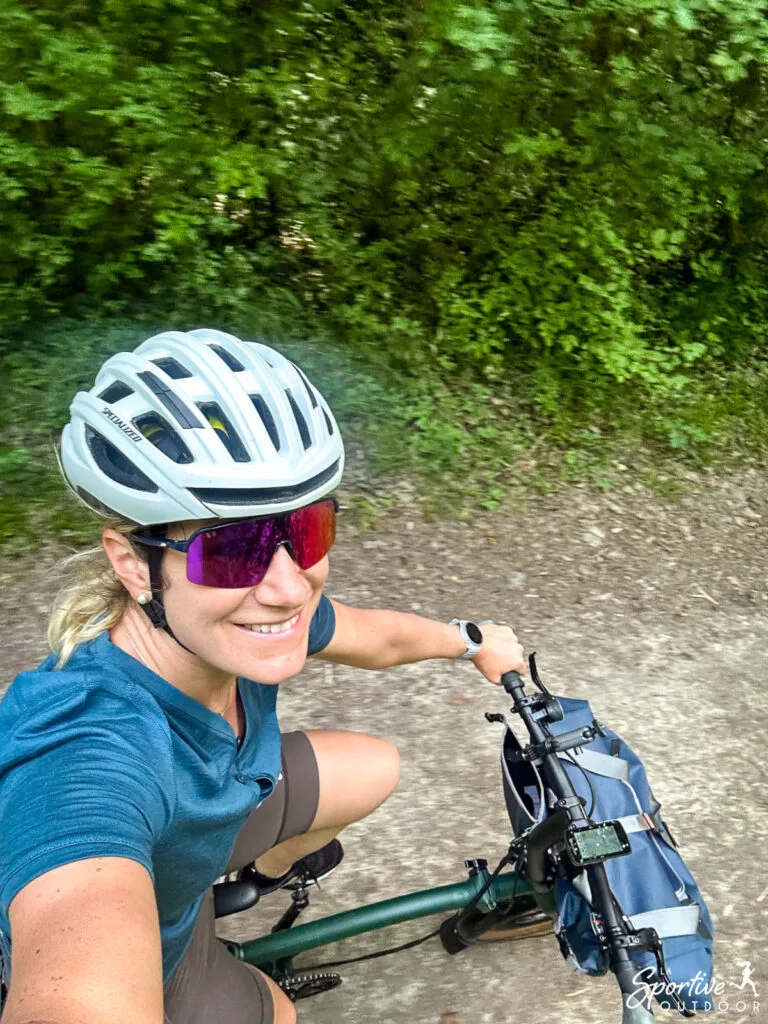
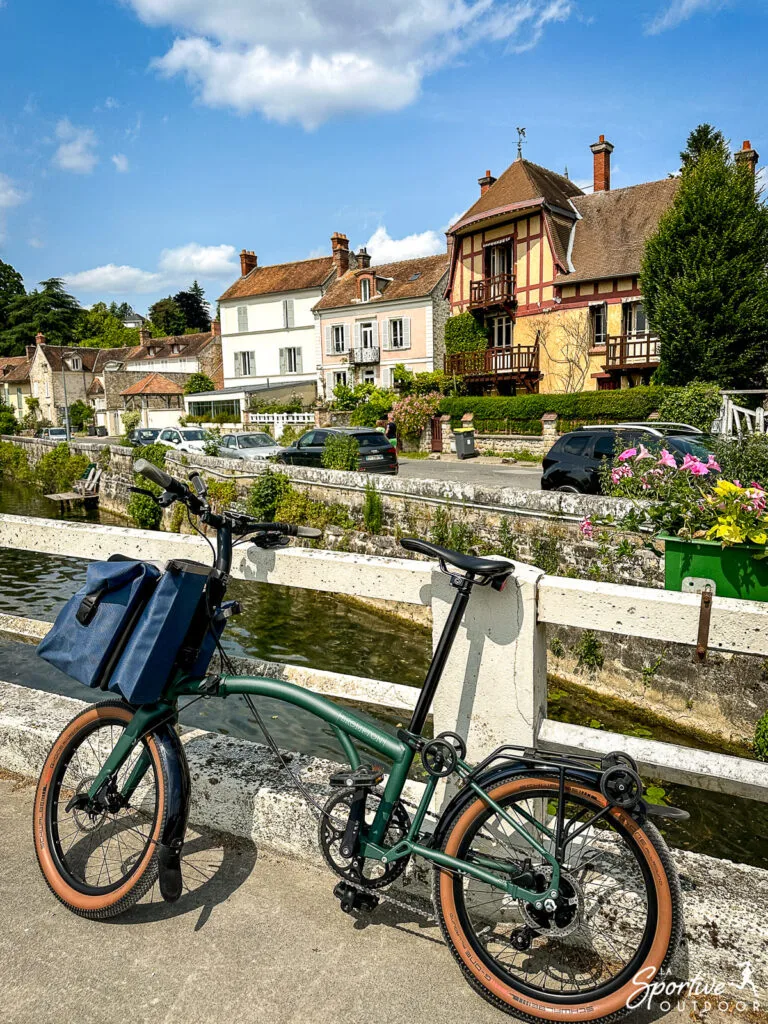
Having said that, for someone who wants to use it more in the city, but enjoy more “natural” trails on weekends or vacations, without being too difficult, it’s a perfect fit, and you’ll clearly have a lot of fun with it on the trails!
A practical little bonus: the mudguards are effective, which is always useful if you don’t want to arrive at an appointment covered in stains 😉

Folded bike comfort
Once folded, the bike stays securely in place: a hook prevents the front wheel from moving, and a small ball locks the handlebars in place. You can then either lift the whole thing, or roll it using the wheels on the luggage rack, in trolley mode. Really well thought-out!
However, I have to say that I didn’t find getting around with the folded bike all that easy. I put it to the test going up and down steps, crossing the Gare de Lyon in Paris at rush hour, going through doors with it, using an elevator, going down and up stairs in a station, taking trains, going through doors to get it into an apartment… In short, quite a few different cases! In short, quite a few different cases!
Its strong point is its compact size, which makes it easy to slip into a train… However, it’s best if the train isn’t too crowded, as it takes up much more space than a C-Line. What’s more, in my opinion it’s still a bit big to take to a restaurant or café: it can be done, but I’d be a bit embarrassed to arrive with it.
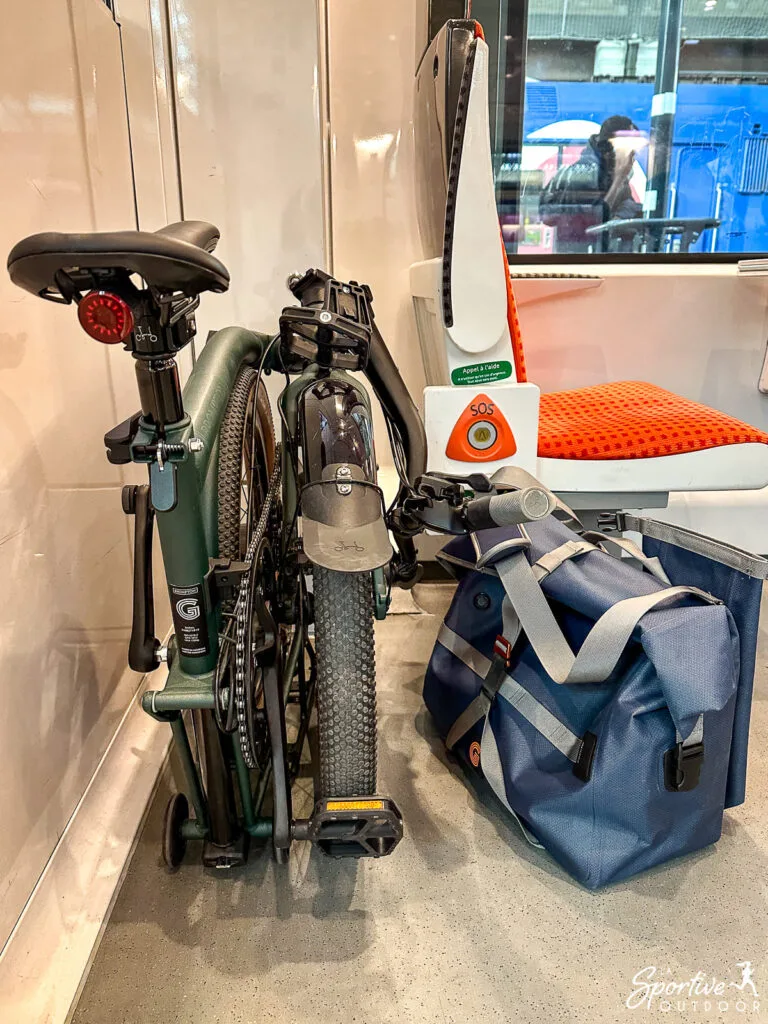
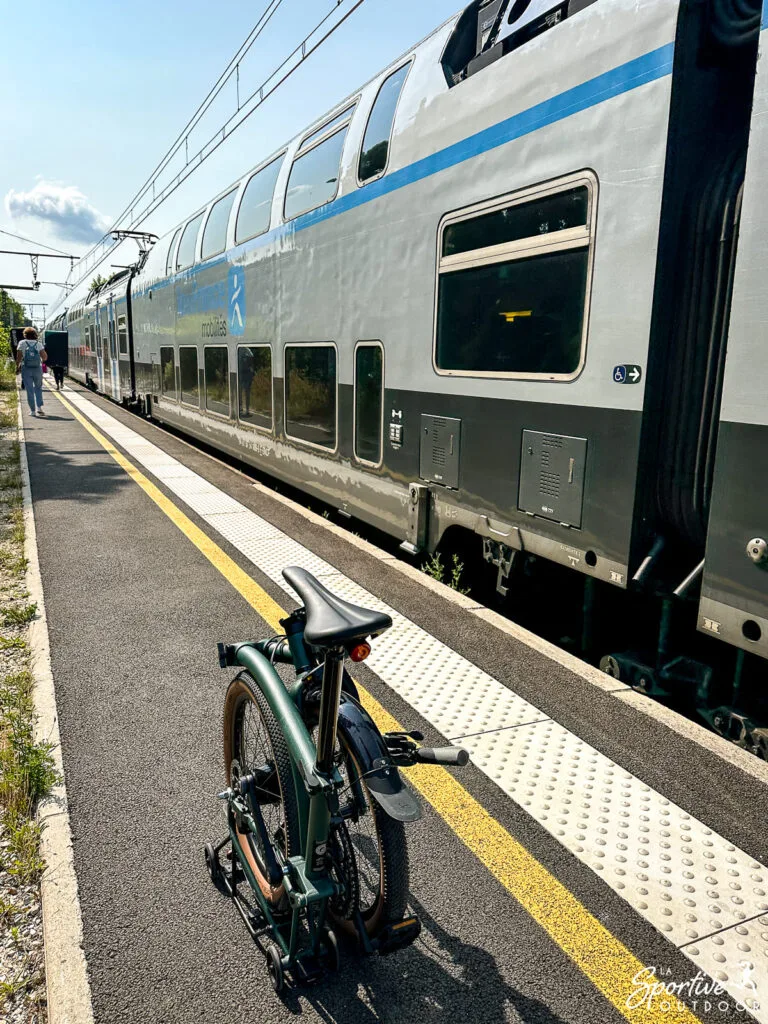
What’s more, with its 15kg weight and substantial volume, I found getting over steps and other obstacles a real hassle, especially as the slightest little ledge meant I had to carry the bike as I bumped into it. I think this may put some people off (and even more so some women), as I’m a bit of a big guy (the kind you call to open jam jars :-P) and found it too heavy, even if I could carry it.
Last but not least, it’s not very maneuverable on wheels either, so zigzagging through a crowded station is a bit of a challenge: it can be done, of course, but it’s not very comfortable.
Bikepacking and panniers
It’s also possible to go bikepacking with the G-Line. It lends itself well to the exercise, since it’s easy to slip into a train and then go just about anywhere.
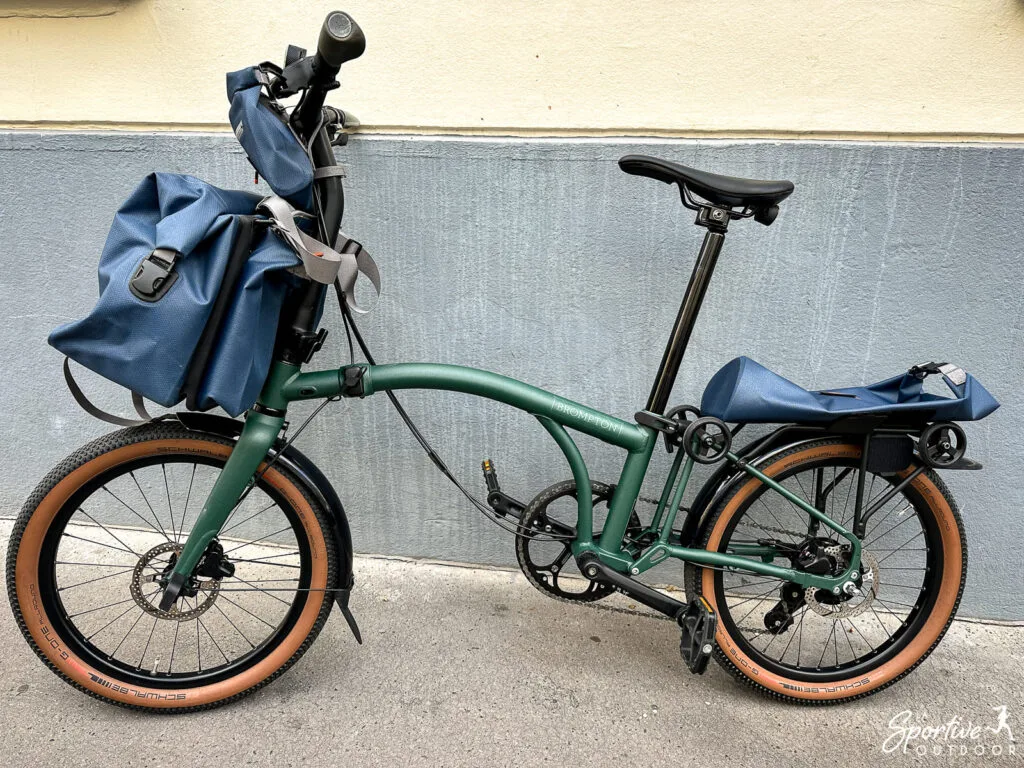
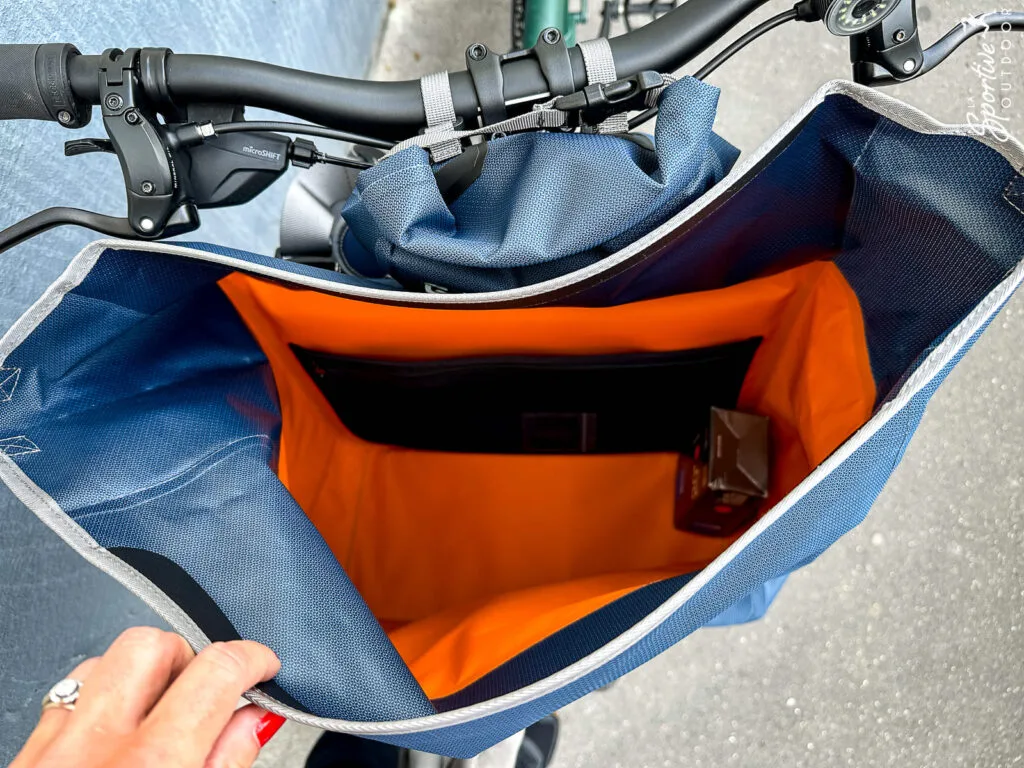
What’s more, it can be fitted with Brompton waterproof panniers, which are very practical in use. Other brands also make panniers for Bromptons, but I haven’t tested them.
With a load capacity of 10kg at the front and rear, you can equip your bike with a huge pannier (25 liters for the large size!) that clips onto the handlebars, as well as a 10-liter pannier that attaches to the rear luggage rack, for example. All the gear you need for a bivouac, for example!

The product was lent to us by the brand. This does not change our opinion, as the brands we work with understand that the idea of the test is to give our opinion, with its positive and negative points. This article contains affiliate links.