


Bikepacking et cyclotourisme – Which bike panniers to choose?

Which bike panniers to choose? Whether you're into team bikepacking or bike touring, weekend or long-distance travel, there are choices to be made. To help you find your way around, I've put together a list of the different types of bike panniers available, their advantages and disadvantages, and my recommendations for tried-and-tested models. Follow the guide!

Video summary
1. Saddlebags for bikepacking
Advantage
- Lightweight: lighter than rear panniers because no luggage rack is required, which can make all the difference on long journeys.
- Storage capacity: offer ample storage space for clothes and sleeping systems.
- Bike handling: less noticeable
- Easy to attach: attach easily to your bike’s saddle and detach quickly if necessary
- Compatibility: they can be adapted to almost any type of bike.
Disadvantage
- Shape: they generally contain a rigid part, and the shape of the saddlebag can restrict the loading of certain rigid objects.
- Practicality: It’s not always easy to get to the bottom of the saddlebag.
- Capacity: less than rear rack-mounted panniers
If you don’t want to use a luggage rack, you can use a saddle bag to carry more volume while gaining in lightness and maneuverability on the bike. Saddlebags attach directly to your bike’s saddle, providing extra storage space without affecting the bike’s handling too much. They’re ideal for long bike rides or multi-day trips, thanks to their increased storage capacity. THE bikepacker’s must-have pannier!
My recommendation
I use a saddlebag from Restrap, the 14L, which fits perfectly, even on my small bike (yeah!). Different sizes are available, from 4.5L to 18L.
The 4.5-liter Restrap pannier is ideal for light trips, when you need to carry a change of clothes and a few essentials, while the 14-liter and 18-liter models are more suitable for multi-day bike tours: they offer enough space for a sleeping bag, Tarp, warm clothes and small travel gear.
Comment soutenir La Sportive Outdoor?
L'une des façons de nous soutenir est de faire vos achats via nos sites partenaires.
L'idée n'est évidemment pas de vous pousser à la consommation: n'achetez que ce dont vous avez besoin mais, lorsque vous le faites, passer par nos liens nous aide car nous touchons ainsi une petite commission sans aucun coût supplémentaire pour vous.
Vous pouvez par exemple en ajouter certains en favoris pour vos prochains achats. Pensez à accepter les cookies de nos partenaires dès l’arrivée sur leur site.
- i-Run: jusqu'à -50% pour les Running Weeks
- Ekosport: -20% extra sur les nouveautés rando et bivouac
- Intersport: des offres sur la randonnée (notamment)
- Muule: 15% de promo avec le code VIP15
- Decathlon: pas mal de bons plans
- Lyophilisé&Co: lyophilisés, nutrition sportive et matos de bivouac
Pour plus de façons de nous soutenir, c'est ici.


2. Panniers on rear carrier
Advantage
- Greater loading capacity
- For transporting bulky items
Disadvantage
- Weight
- Can affect the stability of the bike if overloaded, or even exert too great a strain on the bike’s structure
Essential for touring cyclists, rear panniers are often favored for their storage capacity. A pair of rear panniers can carry bulky items such as clothing, kitchen equipment, a laptop or even the camping system. Beware, however, that excessive rear weight can affect the bike’s handling, as the rider’s weight is already on the bike’s rear wheel!
My recommendation
I recommend the Ortlieb Back-Roller Classic or Ortlieb Back Roller Plus (depending on which look you prefer, they’re both great), a pair of rear panniers appreciated for their sturdiness and large storage capacity.
Its coating and roll-up closure make it watertight to the touch. Its ease of installation is also a strong point, thanks to its Quick-Lock 2.1 fastening system. However, one point to bear in mind is its weight, around 2.5 kg, which can make itself felt on the bike.


3. Front carrier bags and fork bags
Advantage
- Potential for carrying bulky items
- Distributes weight between the front and rear of the bike
Disadvantage
- Impairs handling if weight is too great
- Not suitable for all bikes!
- Be careful not to break the fork!
The main advantage of front panniers is that they distribute the weight on the bike and take the load off the rear wheel. They attach either to a front-mounted rack or directly to the fork. Be sure to check your bike’s compatibility with these… Carbon forks, for example, are often unsuitable, as they are not designed to support this weight.
My recommendation
For your pair of front bike panniers, you can once again rely on the Ortlieb brand. The Ortlieb Sport Roller Classic or Ortlieb Sport Roller Plus front panniers are made from the same high-quality materials as the Back Roller rear panniers.
On the fork bag side, the Fork Pack model, available in 4.1L and 5.8L, is also a good choice if you don’t need too much capacity.


4. Handlebar bags
Advantage
- Essential enough to keep things close at hand
Disadvantage
- If you have a small bike, you’re pretty limited in what you can take with you 😉
Handlebar-mounted bicycle panniers are a practical way of keeping your belongings close at hand while you’re on the move. They’re just as useful for travel as they are for everyday use. This is where you usually put your map, phone, camera, wallet, snacks, rain jacket and so on. Everything you need without setting foot on the ground. If you’ve got more room, this is also the place to put camping gear.
Please note that you need to check the pannier’s compatibility with the model, the size of your handlebars and the spacing between the handlebars and the wheel before buying. For my size S bike, for example, there are (very) few models that fit… In the end, I opted for the Restrap Bar Pack (10L).
Handlebar bags come in a wide variety of shapes, materials and fastening systems. So it all depends on your preferences and what you want to do with them. Of course, you won’t choose the same pannier if you only want to ride for a day, or for a whole week.
My recommendations
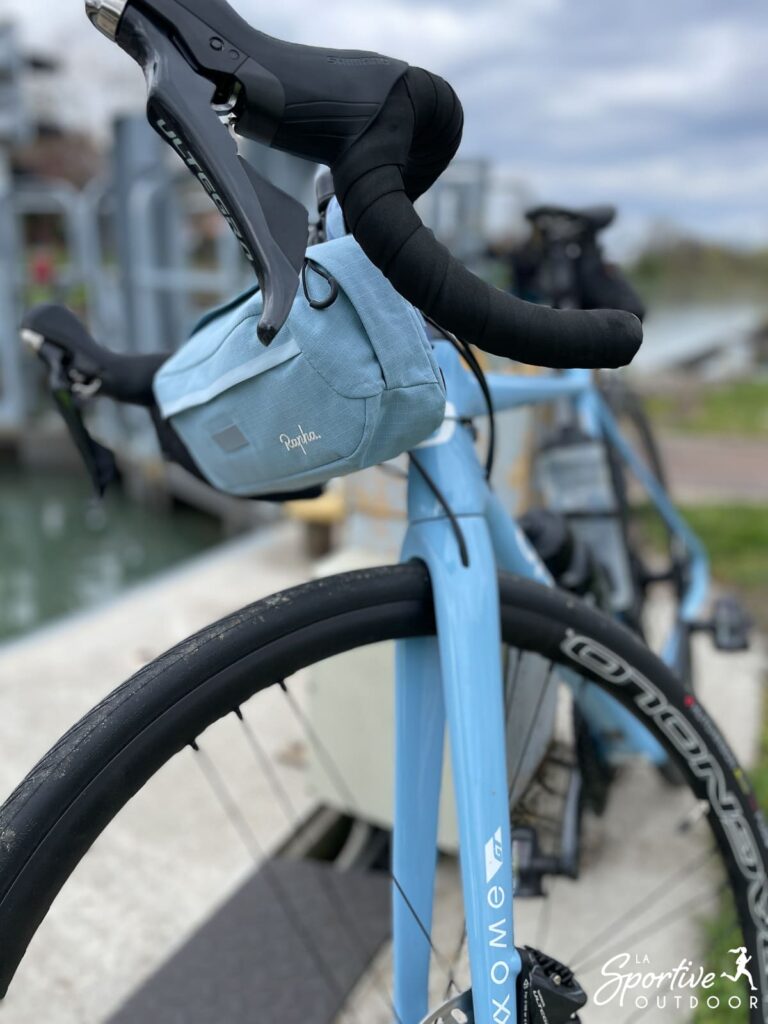
I use a small Rapha pannier on my road bike, which I find ultra-practical for day or 2-day outings in very light mode.
On my bikepacking trips, I opt for the 10L Restrap Bar Pack because the size of my handlebars doesn’t allow for a bigger pannier!
If your bike’s size allows it, the 14-liter Restrap Bar Bag Small is one of the brand’s flagship models, while the 17-liter Restrap Bar Bag Large offers greater storage volume thanks to a removable front pocket that can be added to the 14-liter bag.
I also used an Ortlieb Ultimate Six pannier for a long time. A great classic, a little heavy for a limited capacity (5L or 6.5L), but super practical to attach and open/close, and also perfectly waterproof. It’s perfect if you’re using your handlebar bag to store a few things you’d like to have close at hand! For a larger, more bikepacking-oriented Ortlieb pannier, take a look at the Ortlieb Handlebar panniers (but watch out for the size again!).


5. Bike frame bags
Advantage
- Many different formats
- Easy access, even when driving
- Can be a good place to put the repair kit, for example, and be sure to keep it on the bike at all times.
Disadvantage
- If you’ve got a small bike, you’re pretty limited in what you can take with you 😉
Frame panniers are a practical option for cyclists looking to maximize storage space while balancing weight on the bike. Placed in the center of the bike, they also offer easy access to gear during the ride.
Be sure to check the saddlebag’s width in relation to your bike, so that it doesn’t get in the way when you’re pedaling. Another point to bear in mind is that the size of your frame will be decisive in your choice of panniers… If you have a size S bike, for example, you’ll quickly realize that the choice of frame panniers is very limited, and that they don’t allow you to carry much… You’ll have to compensate with other panniers to get the same capacity! It’s a problem we women often encounter, so measure before you buy!
There are three types of frame bags:
- Standard frame panniers: attached either to the top tube or down tube of the bike. They are compact and ideal for carrying essentials such as a puncture kit or multifunctional tools. But beware of small bikes: even these quickly make bottle cages more difficult to access… Think of side-opening bottle cages for added convenience!
- Full frame panniers: these fill the space inside the frame and can hold a larger volume of gear, from 6 to 14 liters depending on the model. However, they prevent the use of bottle cages.
- Top tube panniers are also mounted on the frame, but this time on the upper part of the frame’s top tube. Even more accessible than the frame panniers, they provide an extra space for small items. They’re great for reaching snacks or your phone while pedaling.
My recommendation
Restrap frame bags come in a range of sizes to fit frames of various dimensions. Among the star products is the Restrap Frame Bag, which I use regularly in size M.
The Restrap Top Tube Bag is also available.


6. Stem bags/food pouch
There are other small panniers that can come in handy, such as stem bags or food pouches , which can be attached to the stem (or something else, as I have no room on my stem!). See photo below, it’s attached to the frame) and can hold a small bottle of water, snacks or even a compact camera. Perfect for keeping things close at hand!
My recommendation
Again, mine is from Restrap and I like it! It’s the Stem Bag model.


7. Bicycle trailers as an alternative?
Bicycle trailers can be an interesting alternative to panniers. They attach to the rear of the bike and can be used to transport objects, materials and even people or animals. This makes them lighter and more stable. Another advantage is their ease of installation: no need to modify the bike’s configuration with a luggage rack, for example. And when the trip’s over, simply detach the trailer. On the downside, the trailer can be uncomfortable to ride on paths instead of roads (it shakes!), or to go around posts if the path is narrow… You may also lose maneuverability. If you’re planning to take public transport, the trailer is immediately more cumbersome and problematic too. Finally, note that a trailer is generally more expensive than a luggage rack + panniers.
There are various types of trailer, including single-wheel and two-wheel trailers:
- Single-wheel trailers offer good manoeuvrability, especially when cornering, but are less suitable for heavy loads.
- Two-wheeled trailers are more stable and can carry heavier loads such as children or animals, but they can be harder to steer and less aerodynamic.
For bike travel, it’s best to opt for a monorow trailer. This type of trailer attaches either to the seat post or to the rear wheel axle. If you’re planning to travel over bumpy terrain, it may be worth choosing a trailer with suspension.
This article contains affiliate links.