

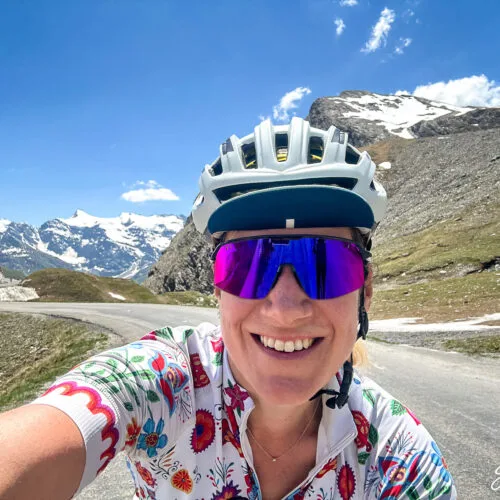
Jenny Diab – 7 weeks solo on the Camino de Compostela

In this interview, Jenny Diab shares with us her experience of trekking as a single woman on the Camino de Santiago de Compostela for 7 weeks. Why did she set off? How did she prepare, and what was the experience like? Here's what she has to say!
Watch the video interview
Listen to the podcast
Read the interview
Today, I’m hosting Jenny Diab from the JD RoadTrip website. I asked her to come and tell you about her experience of Santiago de Compostela, as she travelled the Camino de Santiago from her home in Cahors to Santiago de Compostela for 7 weeks on her own. It’s quite an experience, and I really wanted her to tell us about it!
Introducing Jenny
Jenny, can you introduce yourself?
My name is Jenny. I’ve been blogging for just over 13 years. In 2019, I embarked on the Santiago de Compostela experience, which marked a
You mentioned that it was a trigger. Have you always hiked, or did it really start with Saint-Jacques?
I’ve always loved walking and hiking. For example, even on city trips, like to New York or Los Angeles, I preferred to explore on foot. Sometimes I’d cover 20 kilometers in a day, because I didn’t like taking public transport. So walking is an integral part of my daily routine. Yes, I used to hike, but it’s true that Compostelle was my first long-distance itinerary to that extent.
Why Compostela?
To begin with, I’d like to ask you a question you’ve no doubt answered many times before, but which remains intriguing when you meet someone who has undertaken such a long trek: what motivated you to do the Camino de Santiago?
Comment soutenir La Sportive Outdoor?
L'une des façons de nous soutenir est de faire vos achats via nos sites partenaires.
L'idée n'est évidemment pas de vous pousser à la consommation: n'achetez que ce dont vous avez besoin mais, lorsque vous le faites, passer par nos liens nous aide car nous touchons ainsi une petite commission sans aucun coût supplémentaire pour vous.
Vous pouvez par exemple en ajouter certains en favoris pour vos prochains achats. Pensez à accepter les cookies de nos partenaires dès l’arrivée sur leur site.
- i-Run: jusqu'à -50% pour les Running Weeks
- Ekosport: -20% extra sur les nouveautés rando et bivouac
- Intersport: des offres sur la randonnée (notamment)
- Muule: 15% de promo avec le code VIP15
- Decathlon: pas mal de bons plans
- Lyophilisé&Co: lyophilisés, nutrition sportive et matos de bivouac
Pour plus de façons de nous soutenir, c'est ici.
I already live on the road, in Cahors. So it’s normal to think about it when you see people passing by. But the trigger was that I was traveling a lot. My professional life was pretty good, but it was the personal side that wasn’t going so well at the time. I was going through a bit of a difficult phase with myself, plagued by complicated emotions. I needed something simple. I wanted a clear goal: walk, sleep, eat, walk, sleep, with the aim of reaching the end. I wanted to find myself, because I was questioning my life a lot. So I decided to set off without knowing where I was going.
It’s quite a challenge. As the Camino de Santiago is a pilgrimage for many people, was there a spiritual dimension for you as well?
Not particularly. I’m not at all religious, but the spiritual side came along on the way. In fact, you play the game: you go to churches, you take part in pilgrim masses, and you’re welcomed everywhere. Every evening, there are pilgrim masses, because the route is really organized for that. So you let yourself be carried along. And indeed, I found myself getting emotional in the churches, where I even cried, whereas I thought it was a somewhat neutral place. Everything that was said during the masses and the sharing between pilgrims touched me, especially at that time. I think this spiritual dimension comes with the journey.
Interestingly, it means you can find this spiritual dimension without necessarily being a believer. It’s not necessarily linked to faith.
Yes, I totally agree with that.


Preparing for your trip
For your preparation, I know that there are several variants of the Camino de Santiago. You set off from Cahors, but did you have the choice of taking one route or the other, and how did you make your choice?
No, I didn’t really have a choice. When you set off from Le Puy-en-Velay, there’s a variant to Rocamadour, but I was already on the way. In France, I didn’t have a variant. However, once in Spain, I could choose between the Camino del Norte and the Camino Frances. I absolutely wanted to take the Camino Frances, which is the basic route, the best known and the one that everyone takes. For my first experience, I preferred to go for something classic, the main route.
That makes sense. And how did you prepare physically? You were already walking quite a lot, even if it was in the city. So your body was used to walking. But walking for weeks on end, every day, that’s another story. Maybe you had days off – you can tell us about that. Did you follow any specific preparation for this?
Not at all, really not. I knew I was going to do it, but I didn’t know when. I was really waiting for the right moment, when I felt psychologically ready to go all the way. And, to be honest, it came naturally. A week before I left, I decided that it was time. I knew that the ideal time was between April and September, depending on the weather. It’s true that summer is very popular, especially after the Covid. But I chose to leave out of season, on June 18. From then on, I didn’t prepare anything. I just grabbed my bag, closed the door and left. Clearly.
Sometimes that’s good too.
Yes, that’s it. As I didn’t really know where I was going or what the route was, I set off into the complete unknown. In fact, when I had vaguely inquired, I thought the principle was simple: you walk and you book the same day. But it wasn’t! At my first stop, everything was complete. So I had to get organized and look for a place to sleep. I didn’t find myself in a place full of pilgrims, but alone in a gîte, as everything was booked. I quickly realized that I needed to plan ahead. Later, on the way, I would just book 3 or 4 days in advance to keep a certain amount of freedom.
Okay, that ties in with the question I was going to ask you. How did you plan your itinerary? Actually, you didn’t, did you?
No, it was really spontaneous.

It’s great to go off on a whim, and then discover as you go along!
Yes, that’s right. But you also have to understand that when you walk for a long time, thenumber of kilometers you do at the beginning is not the same as at the end. In the beginning, I knew that walking between 20 and 25 kilometers a day was feasible for me. I based my stages on this, but also on village events and the availability of supermarkets. In the summer, some villages organized festivals, and I knew I could eat well there for cheap, with a nice atmosphere. Sometimes you end up in small towns where there’s nothing. So I looked for places where I could find a pharmacy, buy food or withdraw money. So I stayed between 20 and 25 kilometers at the start, but then I increased my pace, reaching 30-35 kilometers.
In fact, you really have to adapt your steps to your pace and to what you’re capable of doing. There’s also an important mental dimension involved. When you’re going away for a long time, you have to enjoy walking, but it’s also a question of mental strength. For me, doing the whole route, as I did, requires a big psychological part: telling yourself you’re going to go all the way. Once the mind is in place, the body follows. That’s how it worked for me.
It often comes out in the testimonials that there’s an important mental component. But I imagine that equipment also plays a role. You set off a bit unexpectedly, but did you already have certain equipment, like hiking boots that you knew well? Did you have to buy any special equipment, like an adapted backpack? What would be your recommendations for those who want to take the plunge?
Yes, at first, you think you’re leaving with the bare necessities… but even then, you soon realize you’ve got too much. It’s a gradual learning process. For example, during my time in France, I had to send things back by post three times! Books like Miam Miam Dodo were useful for reservations at the beginning, but I soon abandoned them. You can find everything online now. I’d also taken open sandals for walking, but I quickly realized that they weren’t ideal. I ended up sending back a lot of clothes and other useless things.
When I set off, my bag weighed around 12 kilos. By the end, it must have weighed between 7 and 8 kilos, and even then, the difference was mostly food-related. There’s a saying thatyou carry your fears in your backpack, and in my case it was true: I was always afraid of running out of food, so I carried a kilo of pasta and tomato sauce. But I think I ended up in so many villages in France where there was nothing that, in Spain, I always had this. But in Spain, it’s completely different from France!
I didn’t have any walking poles at the time, but if I had to go out again, I’d certainly take them. They help a lot, especially over long distances. As for footwear, I had fairly classic hiking boots, with mid or high uppers, which is useful for crossing the Pyrenees or walking in Galicia, where the terrain is often stony. Today, I’d probably opt for trail shoes, as they’re lighter and more suitable. However, they’re not always ideal in extreme muddy conditions, as I’ve experienced in the fields sometimes in the morning. In any case, I’d ask myself the question: both can do the trick!
I had three T-shirts and some underwear to last a few days without washing. I had technical T-shirts that dry quickly, shorts to keep me comfortable after a hike, and pants that transform into shorts depending on the weather. I also had a light jacket, a compact down jacket that was easy to store, and a down jacket. Down jackets are useful in Spain because, even if you think it’s hot, the nights can be cool, and in the dormitories, if someone opens the window, it’s good to have a down jacket, even if they provide blankets.
I also had a small first-aid kit with everything I needed to treat blisters and small wounds. Pharmacies are easy to find along the way, but it’s good to have everything you need, even if the most important thing is to set off lightly.
A filtering water bottle can be useful, in addition to a normal water bottle, especially when there’s nothing for several kilometers. I’m thinking of a stage in Spain where there’s absolutely nothing, not even a tap. It’s better to have the water you need. I was lucky, it wasn’t too hot or too cold, so I didn’t need a lot of water, but it’s to be expected.
For grooming, I only had the bare minimum: a toothbrush to cut if necessary, and a soap that does it all. No need to carry around a big kit, it’s useless. Minimalist through and through!


Hiking the Camino de Santiago
Can you tell us about a typical day? And did you repeat this typical day systematically, or did you also take breaks to rest?
So… I’ll answer the second question first. Yes, I did take days off, especially at the beginning. You have to realize thatafter ten days, you get really tired. And above all, when you start, you often get blisters. So yes, in the beginning, I sometimes took breaks. I didn’t necessarily make complete stops, but sometimes I skipped a stage by taking a bus, because everything is organized around the route. My day of rest then consisted in taking the bus to continue progressing without walking. In all, I must have had four or five rest days, but no more. It was mostly at the beginning, to take care of my feet and so on.
Then, for the typical day, it’s quite different between France and Spain. In France, as you end up meeting and walking with people, you stay in that friendly atmosphere where you want to keep going together. You get to know each other very well. The hours are pretty standard: you start walking at around 8am, 7.30am or even 7am, depending on the heat. I liked to leave early and arrive early, but in France, I adapted quite well to the people I walked with. This rhythm suited me.
In Spain, on the other hand, by 8pm I was already in bed. By 5am, I was awake, and by 5:30am, I was off. At 6 or 6.30am, I’d stop off at a café for breakfast, typically a coffee and a croissant, and then set off again. Often, I’d finish my stage around noon, 12:30 or even 1pm. It was a rhythm that suited me well, even if it was different from the one I had in France.
Why was the pace so different in Spain? Was it because of the heat, or because the refuges were so crowded and you had to get there early? What explained this difference?
The difference lies in the fact that the route itself is different between France and Spain. In France, the pace is more leisurely, with full board in hostels. There’s this good-natured atmosphere, where you chat with people, make yourself comfortable, and enjoy the encounters. All this helps you get into a nice rhythm, where you enjoy yourself and stay in that dynamic.
But when I got to Saint-Jean-Pied-de-Port, most French people stopped there. I kept going, and found myself all alone. Really alone. I saw all the people stopping in Saint-Jean-Pied-de-Port, and then I said to myself: “OK, I’ll start a new rhythm”. It was a bit like starting all over again. I was surrounded by people from all over the world: Koreans, Spaniards, Italians, Belgians… People who had just started their journey in Saint-Jean, so were still struggling with the Pyrenees crossing, whereas I’d been walking for three weeks.
There were also a lot more people on the way to Spain. As far as I was concerned, I continued to make my reservations, but I kept to this rhythm of booking my accommodation as I went along, over 3 or 4 days. In Spain, I walked mostly on my own, clearly. I had found my own rhythm, and I liked it. I liked walking early, often in the dark with a headlamp. It was a rhythm I’d adopted: at 5am, I’d share on Instagram my stages, the number of kilometers I was going to cover, and where I planned to arrive.
This rhythm suited me, and I felt really in tune with myself. In France, it was more about sharing, so I took time to adapt. At first, you’re a bit lost, you don’t really know why you’re doing this, you’re confronting yourself and your difficulties. The atmosphere among the French gave me a bit of a boost. But once I got to Spain, I knew I was going to go all the way.


At that point, you were in great shape and ready to start?
Exactly, that’s what it was. We were no longer on 20-kilometre stages, but rather 28-32 kilometers. While the others were just starting out and not yet in the rhythm, I was moving fast. And I was hearing comments from people, especially the English, who were saying, “But why are people walking so fast? I don’t understand.” My body was simply well broken in. They wondered, “Yes, but it’s a path, what’s the hurry?”. But in fact, that was the way I was walking at the time. I had maybe 500 km, 600 km under my belt, and they were just starting out: obviously, you’re not at the same pace at all.
These remarks about rhythms never really make sense, because what’s slow for one person may be fast for another. You just have to find your own rhythm.
That’s exactly it.
Listening to you, we get the impression that your trip was divided into two parts: a French part and a Spanish part, with a different atmosphere, a different rhythm, and even different habits. It was a bit like two journeys in one, wasn’t it?
Yes, exactly. And then, above all, the meetings in France… I remember that at one point, we were a group of young people, we were among ourselves, and it’s true that we weren’t making much progress. We were doing 18 kilometers a day, taking our time. Then, one day, I got a horrible cramp in my calf. At the time, I think I wasn’t hydrating enough. That’s when I realized it wasn’t going to work. I wasn’t moving forward. We were together, but we were slowing each other down. It wasn’t what I’d set out to do. So I took a real two-day break and took the bus.
There’s this service, the mail trunk, which can help you if you’re injured or need it. I took care of myself, massaged, and after those two days, I ran into people I’d met earlier who’d made good progress. I picked up their pace, and those with whom I’d stayed far behind.
So I broke out of that comfort zone and left. I found a new rhythm with people I’d met before and with whom I got on well. Among them was an Australian girl with whom I’m still in touch. With this group, we gave each other freedom. Sometimes I walked in front, sometimes behind. We gave each other space to be alone, and that was really cool. That’s when I really found my rhythm, at least for the French part. In fact, we went all the way to Saint-Jean-Pied-de-Port together.
It’s interesting to see how the pace changes over such a long journey. And you, as a woman who did it solo, what was your experience like? Was it easy? Were there times when it was a little more complicated?
No, I haven’ t felt any insecurity or encountered any particular problems. It’s true that you sometimes read stories here and there, but on the whole, whether in France or abroad, the way is quite benevolent. People are attentive. How many times have I stopped to massage my feet, and everyone has asked me if I’m okay, if I need bandages or help. And I’d do the same in return.
It’s true that I came across one or two accommodations that weren’t great, where the place was unsanitary or just business-oriented, but that had nothing to do with the fact that I was a woman. In any case, at the time I left, I didn’t feel any particular problem with that. I met quite a few women walking solo, some even camping. On the whole, the men I met were benevolent, and I think it’s a relatively safe and pleasant way to go.

Great, I’m glad to hear that. Are there any really special moments you remember that were difficult, and how did you overcome them?
I think that, in truth, when I think about it, there are two difficult moments. The first was at the start. I thought, “What am I doing? Why am I doing this to myself, really?”. I stopped, sitting in the middle of the road, with blisters coming on from day one. I was thinking, “Why am I doing this?”. There I was, thinking: “Come on, turn around. You’re not far, turn around”. And in the end, no, I persevered. But it’s true that the start was difficult, especially the first ten days. What’s more, I had completely cut myself off from social networks. I wanted to leave for myself, and that was difficult. I cried a lot, wondering why I was there.
This period was hard because you’re suffering physically, psychologically, and you don’t really understand why you’re doing this. You don’t have any answers to your questions yet. It’s like coming face to face with yourself.
The second difficult moment was when I moved from France to Spain and found myself on my own again. That’s when I said to myself: “That’s hot”. All the people around me, I didn’t know them, I didn’t know who they were. It was confusing for me. And arriving in a new country, where you no longer speak French but English, was difficult. But I didn’t let it get me down. I said to myself, “Go on”.
That’s when I got into the habit of leaving earlier in the morning, so as not to be overwhelmed by all these new people. It wasn’t that I didn’t want to meet new people, but I was already in a dynamic, I’d already been away for a while. I didn’t want to be disturbed by things, not necessarily negative, but which could have destabilized me. So I left early. And in the end, all the people I met along the way were in the same rhythm as me. We’ d say hello, without necessarily chatting, but it was just “good morning, have a nice day”. We’d pass each other and bump into each other again, but we weren’t necessarily staying in the same accommodation. Yes, the beginning of the Spanish part was a bit difficult.
On a more positive note, do you have a nice or memorable anecdote you’d like to share with us?
So, really, the whole way is memorable, clearly. Everything about it is positive. Looking back, it’ s all positive. But I think my last day was the most incredible of all. You have to know something: in Spain, the last 100 kilometers are sacred for the Spaniards. They often come just for those last few kilometers, whereas you come from much further away. So they’re in a festive mood. But you, you’re in a hostel, you’ve just done 1,000 kilometers, and they come home at 3 a.m., stoned, making a huge mess. You get up at 4:30 or 5am. So you’re pissed off, you say to yourself: “It’s a pain in the ass, I’m really into it, they don’t respect me”. Anyway, it was 3.30 a.m., I was awake and I couldn’t get back to sleep. I said to myself: “OK, I’m getting up, I’m leaving”.
It must have been 4:00, 4:30 when I left. It was dark, a thick mist where you couldn’t see 200 meters. And then I passed a guy. I say to myself: “I’m all alone on the path, it’s dark, I’m going to follow him”. So I follow him. I see him turn around from time to time. At one point, he takes out a flashlight and puts it on the back of his bag. Thanks to this, I could see him far into the mist. We kept walking and walking. Then we reach a bar. I’m having a coffee, and he says, “You’re walking well!”. He was Italian, so he speaks to me in English. I say, “Yeah, I’ve been keeping up. He said: “You saw, I put a light on so you could follow me in the fog”. I thanked him, it was really nice of him.
He asks me, “Where are you going today?”. I tell him I normally stop at the next stage. And then he says: “No, you’re not going to stop there, it’s 8:30, you’ve got 20 kilometers to go, you should go all the way today“. I start thinking about it, and I say to myself: “He’s right”. It’s 9am, I arrive at my accommodation, but there’s no point in arriving so early. So I cancel my accommodation and decide to carry on. I did the remaining 20 km, and that day I walked a total of 40 km.
I arrived in Santiago that day instead of doing it in two stages. I ran into this guy again, we picked up our Compostela together at the welcome desk, and we had lunch together the next day. We also had dinner together, and he really made an impression on me. He pushed me and said: “You’ve been walking since France, why stop? He was so right. We’re still in touch, and I often tell this story because he really marked the end of my path and helped me finish it.


Post-trip assessment
Thanks for the anecdote! In the end, did you say to yourself, once you’d finished, “did I find what I came for”?
Speaker #1: Yes, clearly. I already felt it inside me. In the beginning, I was completely cut off. I only had my phone to give my mom an update. But anyone who called me or sent me a message, I didn’t answer. I was so psychologically unwell that I didn’t reply. I lost friends because of that, but it was necessary for me. And in fact, when I arrived in Spain, I started sharing what I was doing again. People were very enthusiastic to see what I was doing, and I really felt a surge of solidarity for the rest of the way.
Yes, it answered a lot of my questions. I travel all the time, I’m on the road a lot, I don’t have a home, and it’s hard to see friends regularly in those conditions. I was questioning myself: “Should I buy an apartment? Do I need a pied-à-terre? A child, perhaps?” A child wasn’t on the cards, because I love my freedom too much for that. But in the end, I bought an apartment, I found the pied-à-terre I needed. I came home at the end of August, and signed for the apartment in December.
It’s amazing, it really helped you find answers and move forward. A few years on, what do you take away from all this?
Honestly, it’s the best experience of my life. I travel a lot, I see incredible places, but this human experience is incomparable. On the road, nobody cares who you are, what you do, how old you are. We’re all on the same level. For me, it’s the “road to freedom”. Nobody judges you, everyone lives their own path. It’s the most beautiful human experience I’ve ever had.
I think about it regularly and tell myself that I have to go back and do something similar again, because it makes me feel good. It’s difficult to organize because of my schedule, but last year I went back. I did the Stevenson route, then I went back on a part of Compostelle that I hadn’t finished. It was good for me, but I realize that I need challenges.
For a few years now, I’ve been hesitating between two things: doing Compostelle again, but challenging myself to do it in less time, or exploring a new route. And right now, there’s a route in Romania that goes from north to south, 1400 kilometers, and it’s really tempting me. I think next year, I’ll go for it.
That’s just great. I hope you’ll come and tell us all about it!
With pleasure.
Tips for women who want to start their own business
Finally, what advice would you give to a woman thinking of doing the Camino de Compostela like you?
Frankly, you’ ve got to go for it. Honestly, you shouldn’t be afraid, because first of all, if you do the French part, you’re in France, so you’re in your own country. And Spain isn’t far away either. Nowadays, everything is set up for the Camino de Compostela: there are buses, restaurants, gîtes… And then, thanks to the Internet, there are also Facebook groups where you can get help if you have a problem.
But honestly, you shouldn’t start out with any preconceptions. It’s a super-accessible path, and even if you like to control everything, there’s everything you need to get organized. At first, you may want to book and plan everything, but as you go along, you learn to let go. I think it’s a great way for a woman to get started, to give herself a challenge.
It’s not dangerous at all. You meet so many people on the way that, frankly, you’d have to be really unlucky for something to happen. The path is benevolent, and these days, a lot of women do it solo. So really, you don’t have to wait for someone to go with you, you don’t have to wait for friends to be available. Just go for it. It’s easy, and there’s everything you need to get organized. So go for it!

Follow Jenny
It’s the perfect way to end your message! And where can we follow you online?
I share a lot on my Instagram, @jdroatrip. And I think if I go back to do the Romania route, I’ll share it daily, clearly. People like to see that. They like to see that you’re struggling, that’s clear, but they also like to see if you’re going to go all the way and make it!
After that, I’m also on Facebook with the same name, jdroatrip, or my personal Jenny Diab page. And then there’s my website, jdroatrip.tv, where you can find all my experiences, whether on the Stevenson or Compostela trails, where I’ve written an article for women who want to get started too. So there’s a lot to do with that, and with the hikes I can do as a solo woman.
Great, thank you so much for sharing this. You’ve given us lots of information and you’ve really made me want to go!
With great pleasure, it was great to be able to talk about it again. I’m always happy to talk about it, I never get tired of it.