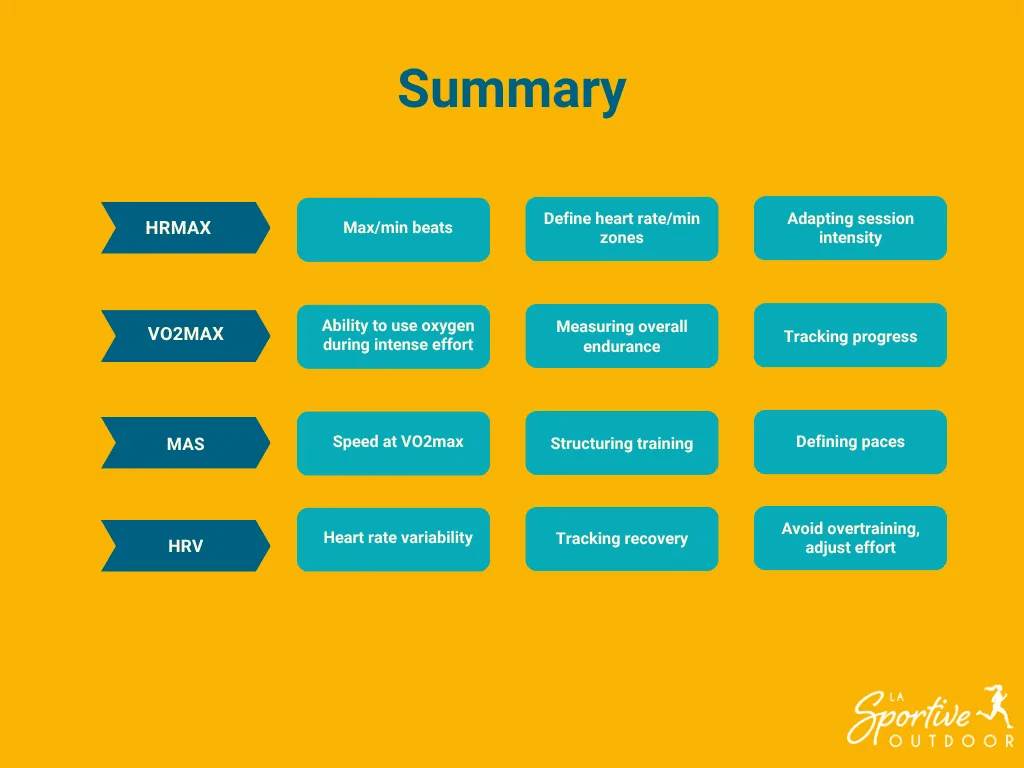


Understanding the usefulness of HRmax, VO2max, MAS and HRV

When you start running, you quickly hear about HRmax, VO2max, MAS and HRV. These terms may seem technical, but they're very useful for improving your training, progressing, managing your efforts and avoiding common mistakes, such as overtraining. Here's a simple guide to what these indicators are for, even as a beginner runner.

HRmax – Maximum heart rate
Understanding and determining your HRMax
The maximum heart rate corresponds to the maximum number of heartbeats per minute that your body can achieve during very intense effort.
Heart rate (or HR) is a key element in effective training. It reflects the way the body reacts to effort, and this reaction is unique to each individual. Many factors can influence it: fatigue, stress, training level, diet or even weather conditions such as heat or cold. That’s why it’s so useful for adapting training to each individual. Bear in mind that everyone has their own maximum heart rate (HRmax).
The classic formula,“HRmax = 220 – age”, is still too often misused. It doesn’t reflect the reality of your true HRmax. Field tests such as the Cooper, ½ Cooper, VAMEVAL or hill climbing sessions performed with a heart rate monitor are relevant. The same applies to laboratory effort tests, which provide a reliable measurement.
Note that your HRmax may vary according to the sport you practice (running, cycling, etc.). If you practice several disciplines, it’s important to determine your HRmax for each of them.
Using HRmax
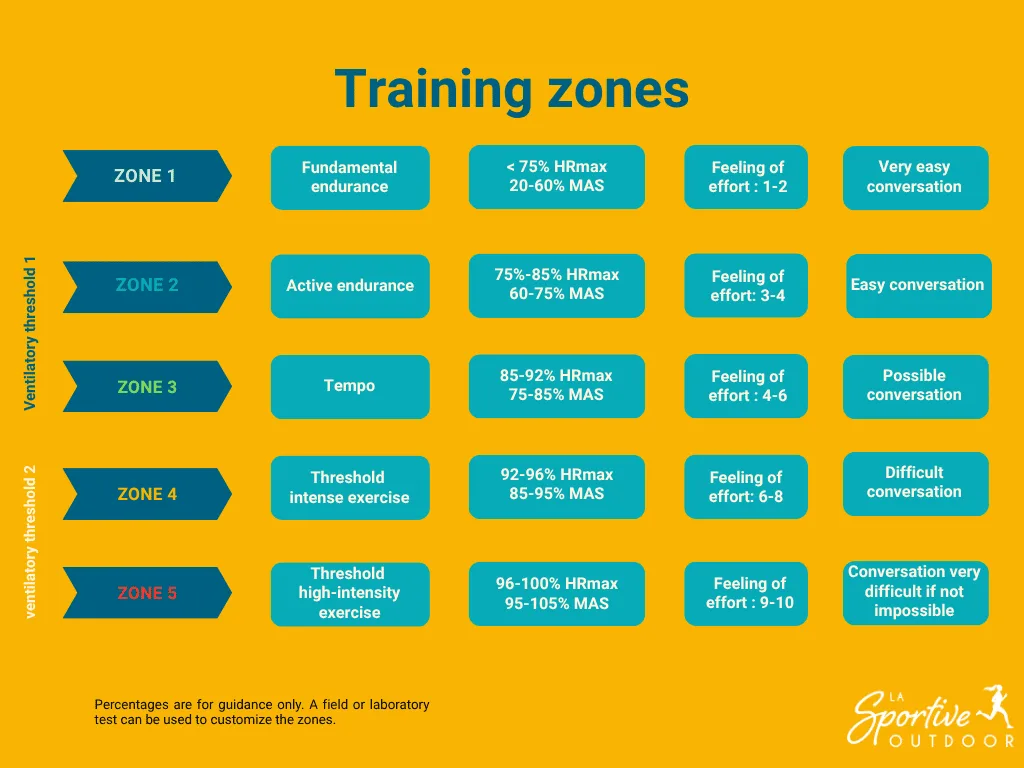
HRmax can be used to define training zones as a percentage of this value, enabling training to be structured. This helps to adjust the intensity of sessions to each athlete’s profile. This HRmax allows us to define a model with 5 heart rate zones, corresponding to 5 training zones. The most common model is as follows:
- Zone 1 or fundamental endurance, for sessions below 75% of HRmax
- Zone 2 or active endurance, for exercises performed between 75% and 85% of HRmax
- Zone 3 or tempo, for higher intensities between 85% and 92% of HRmax
- Zone 4 or threshold, for intense exercise between 92% and 96% of HRmax
- Zone 5 associated with flat or uphill MAS, close to VO2 max, for very intense sessions
VO2max – Maximum oxygen uptake capacity: aerobic potential
VO2max is the maximum amount of oxygen your body can use per minute during intense effort. Having a higher VO2max partly enables you to run longer and faster (it’s not the only condition). It evolves with training and can therefore be used to monitor your progress over time.
Comment soutenir La Sportive Outdoor?
L'une des façons de nous soutenir est de faire vos achats via nos sites partenaires.
L'idée n'est évidemment pas de vous pousser à la consommation: n'achetez que ce dont vous avez besoin mais, lorsque vous le faites, passer par nos liens nous aide car nous touchons ainsi une petite commission sans aucun coût supplémentaire pour vous.
Vous pouvez par exemple en ajouter certains en favoris pour vos prochains achats. Pensez à accepter les cookies de nos partenaires dès l’arrivée sur leur site.
- i-Run: jusqu'à -50% pour les Running Weeks
- Ekosport: -20% extra sur les nouveautés rando et bivouac
- Intersport: des offres sur la randonnée (notamment)
- Muule: 15% de promo avec le code VIP15
- Decathlon: pas mal de bons plans
- Lyophilisé&Co: lyophilisés, nutrition sportive et matos de bivouac
Pour plus de façons de nous soutenir, c'est ici.
Connected watches (Garmin, Polar, Coros, etc.) can estimate it, but this is not always accurate. There are also laboratory and field tests using indirect estimation via MAS.
The heart plays a key role during exercise: it sends blood, and therefore oxygen, to the muscles. The better trained and stronger it is, the better it can supply the body, especially during intense exertion. For this to work at its best, the heart needs to have the right volume (like a large reservoir) and to beat efficiently (good heart rate). As a result, you run longer, more efficiently, and tire less quickly.
We’ve already discussed the indirect estimation of VO2max via MAS. How do you define your MAS and how do you use it?
MAS – Maximum aerobic speed
MAS is the running speed at which you reach your VO2max. It’s a speed you can maintain for between 4 and 8 minutes, depending on your level.
It serves as a reference for planning training sessions: splits, specific running paces, threshold development… It’s a central tool in a runner’s progression. To find out, you can carry out a test in the laboratory, but also on a running track or on flat ground. If you’re looking to determine your maximum ascent aerobic speed, perform a hill test. The following tests are recommended:
- The ½ Cooper: On a track, the challenge is to cover the greatest distance in 6 minutes. After a 20-minute warm-up protocol, you run intensely for 6 minutes, followed by a recovery phase. The distance covered over the 6min, multiplied by 10, gives you your MAS.
- The Vameval test : This is a progressive test with a soundtrack. After a warm-up, you follow a set speed progression that increases every minute, until you reach exhaustion. It’s a good way of assessing not only your MAS, but also your endurance, your mental attitude and your HRmax.
- The Léger shuttle run test: You run from one peg to the next, over a distance of 20 metres, at an increasingly fast pace. The speed increases with each step.
- The hill test: After a 20-minute warm-up, run for 4 to 8 minutes at maximum speed on a steady climb. Calculate your vertical speed: (D+ (m) / time (h))= (ascent covered x 3600 sec (1h)) / elapsed time (sec). You’ll get different ascent MAS values depending on the percentage of slope chosen (gentle slope below 30% and steep slope above 30%).
Understanding your MAS is a real plus for progress in running. It gives a good indication of your level and helps you structure your training.
But beware: MAS is only one tool among many. It’s not enough on its own, especially if you’re preparing for long distances like ultra-running.
HRV – Heart rate variability: for better recovery management
HRV, or heart rate variability, measures the variation between two heartbeats. It reflects the state of your autonomic nervous system, which manages stress, recovery and adaptation to exercise.
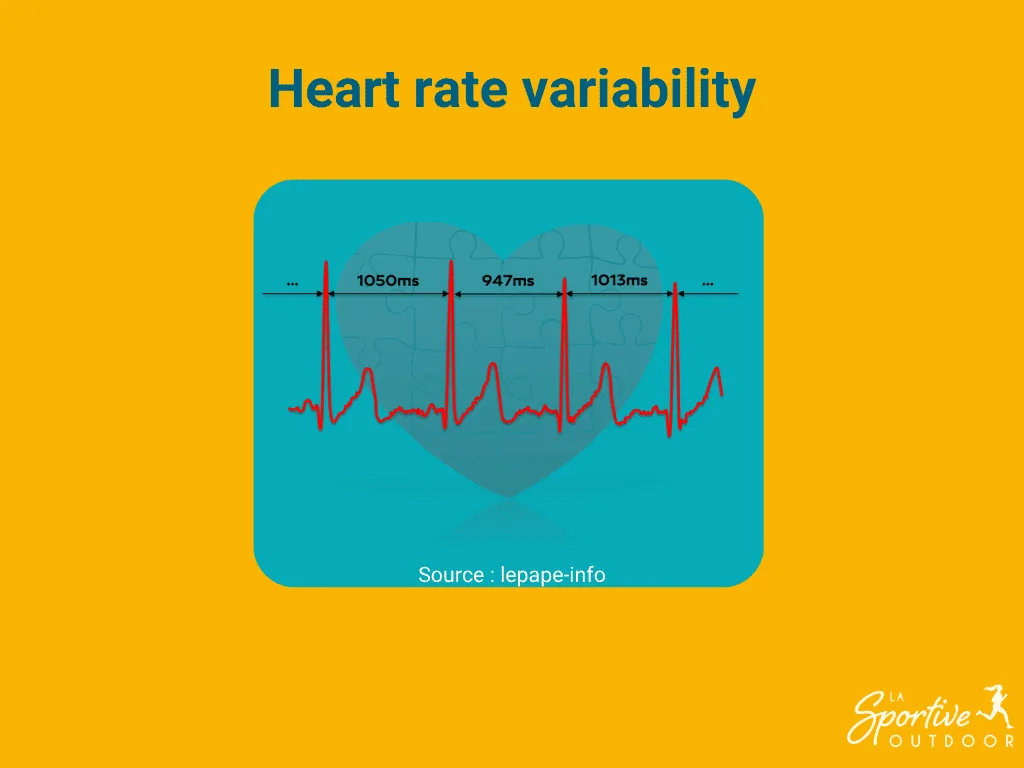
A high HRV, translated by large variations betweenheartbeats, shows that your body is adapting well to training. It’s often a sign of good physical and mental balance, and that you’re in good shape.
Conversely, a low HRV may be a sign of increased fatigue or high stress, whether emotional, physical or due to excessive training load. It allows us to analyze how the athlete reacts to various stress factors, whether related to training, lifestyle, environment or mental health.
It’s important not to compare your HRV with that of others: each individual has different basic values. What counts is your personal trend over time.
HRV is a relevant tool, but it’s generally not the priority at the start of training: other simple levers such as regularity, sleep or load management are often more effective to implement first.
But how do you follow it? With a specific application such as Nolio, HRV4Training, Elite HRV or directly on certain watches (Garmin, Polar, etc.). Measurements should preferably be taken at rest, in the morning when you wake up.
Summary
As a beginner, you don’t need to master everything right from the start, but understanding these concepts will enable you to :
- Listen to your body
- Tailor your sessions to your level
- Steady, secure progress
- Avoid injury or excessive fatigue
You don’t need any sophisticated equipment: a cardio watch, a well-chosen app, or even just how you feel. What really makes the difference is training that’s adapted to you, your pace and your level, and regular follow-up to adjust over time.