


Preparing your first bikepacking trip – Practical guide

With summer here—and its sunny weekends and longer days—it’s time to try something that’s been catching your eye for a while: bikepacking! But where do you start? Follow the guide I've put together for you!

Summary
How do I find routes for a bikepacking trip?
The chosen route, commonly referred to as the “trace,” can be on road or gravel. Gravel routes are generally a mix of road and trails. The technical difficulty of gravel riding depends on the region chosen. Don’t forget—on a gravel ride, you can always get off your bike!
The easiest way to get started is to retrieve existing traces:
- Many tourist offices have developed gravel routes suitable for bikepacking, which you can find on their websites.
- Komoot develops collections that you can find directly with your search engine.
- Komoot has also created an “itineraries” option , allowing you to retrieve routes around a given point.
The next step is to plot your own routes… Be careful, it can be very addictive! And don’t forget that the first route may not be perfect, but it won’t matter – you’ll have stories to tell! In bikepacking, there’s always the unexpected, and that’s what gives you a taste for adventure!

Which bike to choose?
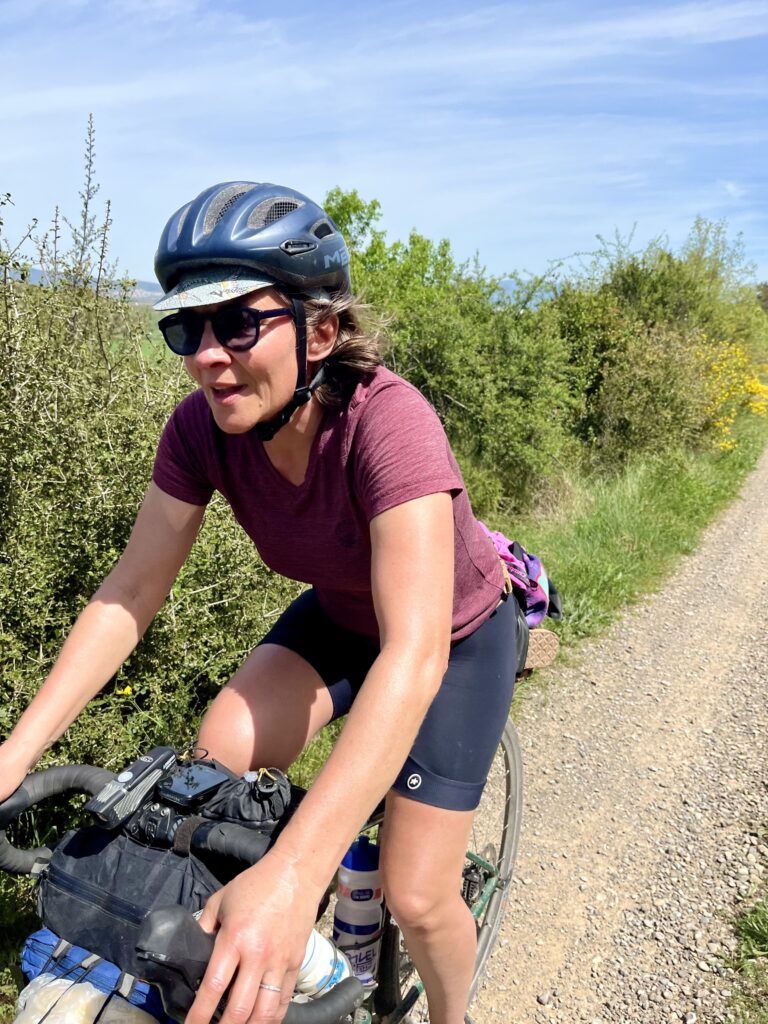
Bikepacking promotes a new, lighter, and more athletic way of traveling. That’s why a gravel bike is the best choice. Its versatility allows you to ride on both roads and gravel. Its light weight also makes it easy to carry or push if you need to get past an obstacle or a difficult section. It also lets you have fun, navigating bumpy trails while feeling safe.
Good to know
You don’t need the latest gear to get started! An old bike, a rickety bike rack, and a well-worn tent will do just fine. Here, we’re sharing the ideal equipment with you, but don’t let the pursuit of perfection hold you back from getting started.
When choosing a gravel bike, focus primarily on the following two factors. Your choice will then depend mainly on your budget and how you plan to use it.
- The frame (and fork) component:
- Carbon is the lightest, but also more fragile and more expensive. It is favoured for gravel racing.
- aluminum is versatile and the least expensive material.
- steel is favored in adventure and travel gravel because it can be repaired anywhere in the world and last a lifetime, but it’s heavier.
- titanium is lightweight and reputedly unbreakable, but very expensive.
- The groupset: Shimano , SRAM and Campagnolo share the market, with entry-level and premium groupsets. Here’s a comparison table to help you make your choice.


How do I take the train from home?
To get started with bikepacking, the easiest and most enjoyable way is to set off from home. However, leaving a big city and its urbanized surroundings isn’t necessarily the most convenient option. We therefore recommend hopping on a TER or a regional train. Traveling by train with your bike is always a unique experience and isn’t always the most comfortable, but once you get the hang of it, you won’t be able to do without it!

Most TER and regional trains allow bicycles to be transported without disassembly in designated carriages, with no reservation required and at no extra charge. However, regulations in some regions are becoming stricter in response to the rise of bicycle travel and sometimes require advance reservations, particularly to track the number of cyclists. Be sure to check the rules for the region you plan to visit before setting out.
Comment soutenir La Sportive Outdoor?
L'une des façons de nous soutenir est de faire vos achats via nos sites partenaires.
L'idée n'est évidemment pas de vous pousser à la consommation: n'achetez que ce dont vous avez besoin mais, lorsque vous le faites, passer par nos liens nous aide car nous touchons ainsi une petite commission sans aucun coût supplémentaire pour vous.
Vous pouvez par exemple en ajouter certains en favoris pour vos prochains achats. Pensez à accepter les cookies de nos partenaires dès l’arrivée sur leur site.
- i-Run: jusqu'à -50% pour les Running Weeks
- Ekosport: -20% extra sur les nouveautés rando et bivouac
- Intersport: des offres sur la randonnée (notamment)
- Muule: 15% de promo avec le code VIP15
- Decathlon: pas mal de bons plans
- Lyophilisé&Co: lyophilisés, nutrition sportive et matos de bivouac
Pour plus de façons de nous soutenir, c'est ici.
Once you’ve got the hang of it, you can move on to the second stage, enabling you to go further afield, or come back from further afield: the TGV.
Good to know
The TGV has a few (rare) places for unassembled bikes (depending on the line), which you can reserve when you pick up your ticket. But the most flexible solution is to dismantle the front and rear wheels and wrap your bike in a lightweight cover. I recommend the La Virgule cover, made from recycled parachute fabric, which is very compact, light and hot!
What clothes should I bring?
When it comes to bikepaking, you have to be smart to pack light! We use the 3-layer system (breathable, insulating and protective). For several days, here’s a list of recommended clothing:
- Down jacket
- Hardshell rain jacket
- Ultra-light windproof jacket
- Legwarmers
- Sleeves
- 2 merino jerseys
- 2 shorts
- 1 piece of evening wear
- flip-flops for the evening
Good to know
For down jackets, you can find very compact and warm ones at Décathlon and Uniqlo. If you opt for sustainable materials and responsible design, Vaude is a good reference, with its excellent hardshell jackets that will protect you from the rain in all circumstances!
As for the choice of bike shorts, it’s very personal (but here’s an article to guide you): one of the references in bikepacking shorts are Wilma’s Wild shorts, with removable pads. This allows you to have just one pair of shorts and swap pads every day!

What equipment do you need to bivouac?
Have you chosen bikepacking for the adventure , and is your goal to spend every night—or just a few—outdoors ( wild camping or at a campground)? You will need:
- 1 tent OR if you wish to sleep under the stars: 1 bivy (waterproof oversack)
- 1 sleeping bag
- 1 inflatable mattress
- 1 survival blanket that can be used as a tarp.
Decathlon is the go-to brand for affordable, high-quality camping gear . For those looking for higher-end options, bikepackers often opt for a SeaToSummit sleeping bag and sleeping pad, as well as a Sol3 bivy.
Good to know
In general, sleeping gear is placed in front, on the handlebars. You need to check the width between your 2 coasters to ensure that a pannier or tent fits properly (especially for women’s bikes, which are often smaller, so you really need to be careful). To attach your tent, don’t hesitate to use straps, which will come in handy in all circumstances!


What equipment do you need for eating and cooking?
For your first bikepacking trip, it’s easier to start without bringing any cooking gear. You can then go grocery shopping at the end of the day to prepare a cold meal for dinner, or head to a local restaurant.
Here’s what you’ll need for a light option:
- a small, very compact 10L backpack, which you unroll only when you’re running errands (easy to find at Décathlon, for example)
- a knife that cuts well (Opinel, Laguiole or Swiss Army knife)
- a set of cutlery
For the full autonomy option, here’s what you need to add:
- built-in stove(Jetboil type)
- if there are several of you: plates.
How do you transport your bikepacking equipment without being too bulky?
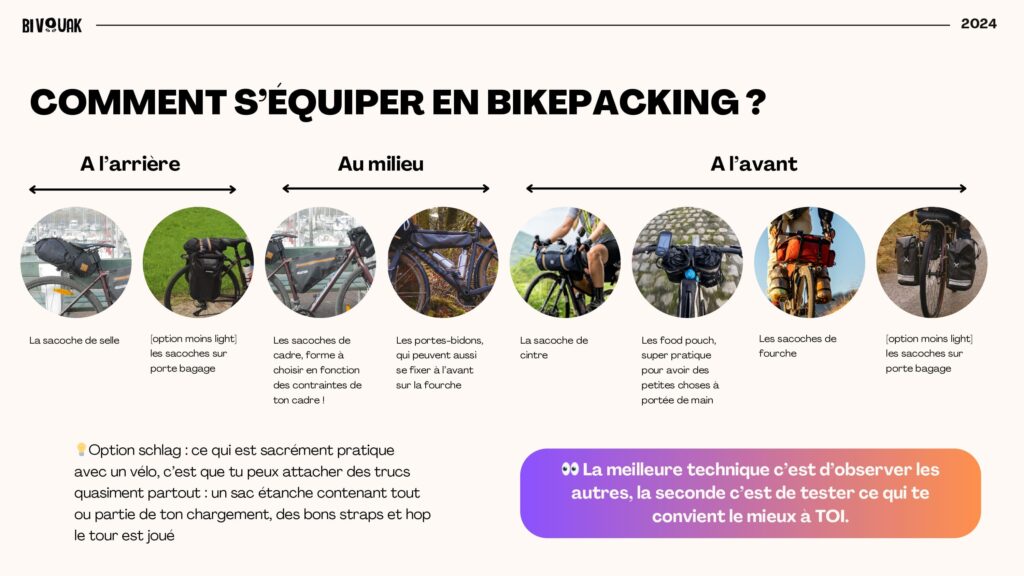
The choice of panniers depends entirely on the degree of autonomy you desire throughout your adventure: do you want to bivouac or sleep in a hotel? Do you want to visit restaurants and bakeries, or cook for yourself? To begin with, choose the main panniers:
- Saddle bag
- Handlebar bag
- Food pouch (small bag for snacks or other items, such as a camera)
Depending on your wishes, and if you decide to go away for longer than a weekend, you can add..:
- Frame bag
- Fork bags
Get started!
And there you have it—now you know everything! It’s time for an adventure off the beaten path, nights spent outdoors, that feeling of being alone in the world, in a region you don’t know: it’s the call of freedom and independence, of adventure and the forest—you’ve got to go! If you want to get started with confidence, you can also join organized bikepacking events, where you’ll meet new friends and get your feet wet. But don’t forget that the essence of bikepacking is that nothing goes as planned—it’s all about the adventure, so just go for it!
This article contains affiliate links.