

How many kilometers a day when bikepacking?

How many kilometers per day should you allow for a cycling trip? It's obviously difficult to give a universal answer to this question, as there are so many criteria to take into account. In general, a cyclotourist covers around 50 to 80 km per day, but this is only an average. In this article, I give you the elements to help you determine the ideal number for you!
The video
Average daily mileage for cycle touring
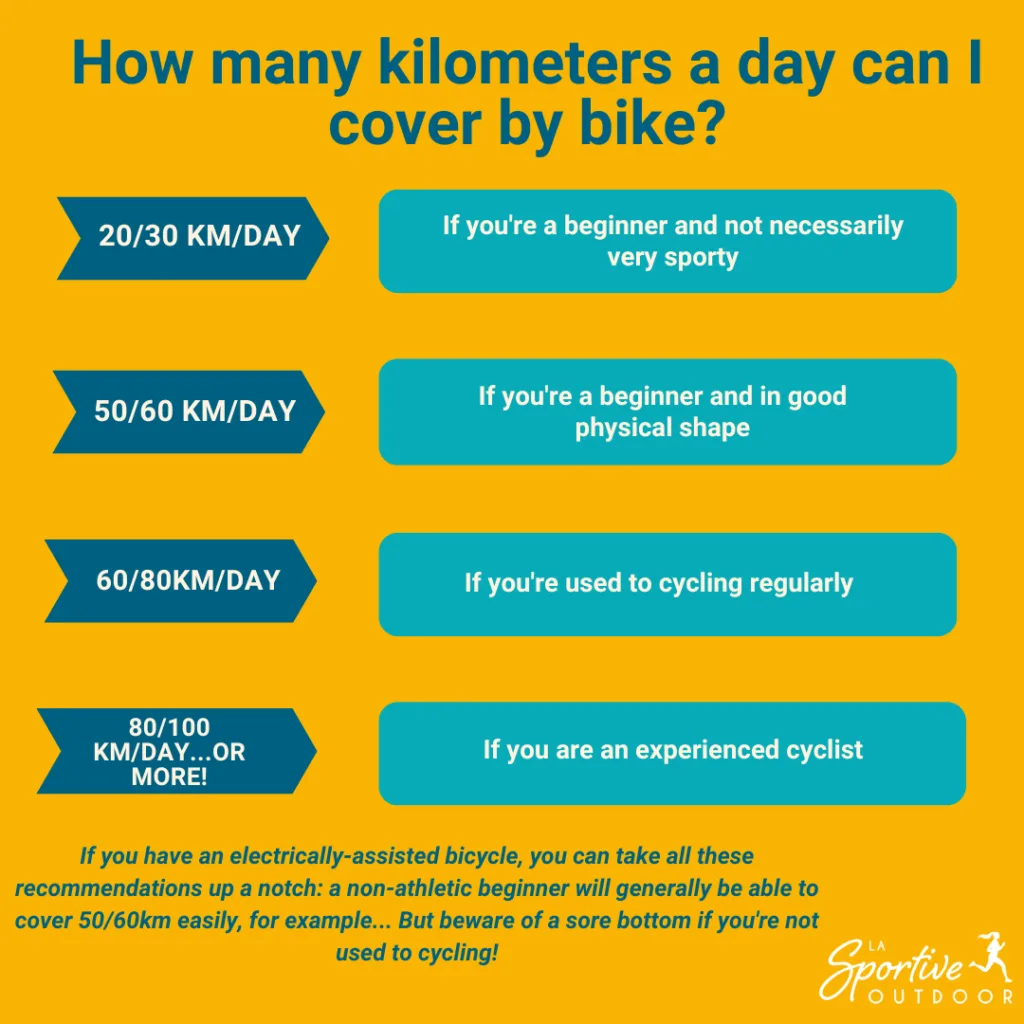
Determining the km/day of your trip is an essential step in preparing for a cycling trip. Here are some general recommendations to help you get a clear picture of your daily cycling kilometers, but remember that these numbers need to be weighted according to all the factors listed below:
- If you’re a beginner and not necessarily very athletic, it’s best to start with short distances: start with bike rides of 20 to 30 km a day and gradually increase the distance according to your comfort level.
- If you’re a beginner in good physical shape, you can aim for between 50 and 60km a day.
- If you’re used to cycling regularly, you can aim for between 60 and 80 kilometers a day.
- If you’re an experienced cyclist, you can aim for between 80 and 100km a day… Or more!
If you have a VAE (electrically-assisted bicycle), you can take all these recommendations up a notch: a non-sporty beginner will generally be able to cover 50/60km with ease, for example… But don’t get too carried away if you’re not used to spending time on your bike: you could end up with a sore bottom 😉
Factors to consider
The most important factors to consider when determining your number of kilometers per day are :
- bike tour participants
- your fitness level
- gradient
- type of terrain (road, gravel, dirt, mud, etc.)
- the wind
- heat
- type of bike (trekking, road, gravel)
- the weight of your equipment (double side panniers or bikepacking-type panniers)
- your travel objectives
Bike trip participants
Of course, there are many different ways of organizing a cycling trip, whether as a family, solo, in pairs or in a group! If you’re traveling with children, be sure to plan stages that correspond to their habits and abilities, so as not to overwhelm them. If you’re traveling in a group, take into account the time lag inherent in groups: the right mileage will ensure that you’re not always stressed about timing.
Fitness level and cycling habit
Your level of fitness is one of the determining factors, which must be taken into account in conjunction with your cycling habit. Yes, because in addition to your general level of fitness, there’s another parameter that could ruin your life… The famous “sore bum” also affects athletes who are in very good shape but aren’t used to spending time on a bike!
Vertical rise
Here’s a classic beginner’s mistake: planning a number of kilometers per day without considering the difference in altitude… Except that it actually changes everything! Flat routes allow you to cover more kilometers with less effort than hilly or even mountainous ones. Find out all you can about the route you’re planning, and adjust your daily mileage according to the difference in altitude you expect to cover: fewer kilometers in the mountains, more on flat routes!
Comment soutenir La Sportive Outdoor?
L'une des façons de nous soutenir est de faire vos achats via nos sites partenaires.
L'idée n'est évidemment pas de vous pousser à la consommation: n'achetez que ce dont vous avez besoin mais, lorsque vous le faites, passer par nos liens nous aide car nous touchons ainsi une petite commission sans aucun coût supplémentaire pour vous.
Vous pouvez par exemple en ajouter certains en favoris pour vos prochains achats. Pensez à accepter les cookies de nos partenaires dès l’arrivée sur leur site.
- i-Run: jusqu'à -50% pour les Running Weeks
- Ekosport: -20% extra sur les nouveautés rando et bivouac
- Intersport: des offres sur la randonnée (notamment)
- Muule: 15% de promo avec le code VIP15
- Decathlon: pas mal de bons plans
- Lyophilisé&Co: lyophilisés, nutrition sportive et matos de bivouac
Pour plus de façons de nous soutenir, c'est ici.
Type of land
The type of terrain on your route also plays a crucial role. Whether you’re riding on a smooth cycle path or on a dirt road that’s potentially muddy if it rains, the effort will be completely different, so you’ll need to adjust the number of kilometers accordingly.
I have friends who once set off to cycle the Canal du Midi without asking any questions, imagining the terrain to be rolling, only to find themselves facing the towpath and its roots… The stages they’d planned suddenly seemed very long, even though they’re used to riding!
Wind
It may sound silly, but wind is an essential factor to take into account! You’re going to tell me that it can’t be predicted, but in fact it depends on the case! There are places where the wind always blows more or less in the same direction, so it’s best to find out in advance about the planned itinerary. I learned this the hard way on theElbe by bike, which I clearly should have done the other way round. Wasting your life over 1,200km is a bit silly 😉
Heat
When it comes to weather conditions, heat is also a factor not to be overlooked. Sensitivity to heat varies from person to person, so it’s best to get to know each other, but in any case it’s wiser to adapt your bike tour to the conditions. You could, for example, set off early in the morning to escape the hottest hours of the day, or choose to travel in a cooler season.
Equipment: bike and panniers
The type of bike (mountain bike, gravel bike, mountain bike, road bike, electric bike…) and the weight of your equipment have an impact on the distance you can comfortably cover. A touring bike loaded with panniers will be heavier and therefore considerably slower than a lightweight racing bike. Take the weight of your load into account, and don’t hesitate to test your loaded bike around your home before your cycling trip to see for yourself: you’ll feel every extra kilo!
Aim of your bike tour
Here’s another essential point: ask yourself what your objective is for this tour. Is it to cover as many kilometers as possible in a short space of time, in a rather sporty travel style, or rather to take your time and enjoy the scenery, stopping to visit places along the way? Your objective will influence the number of kilometers you wish to cover each day.
My biking experience
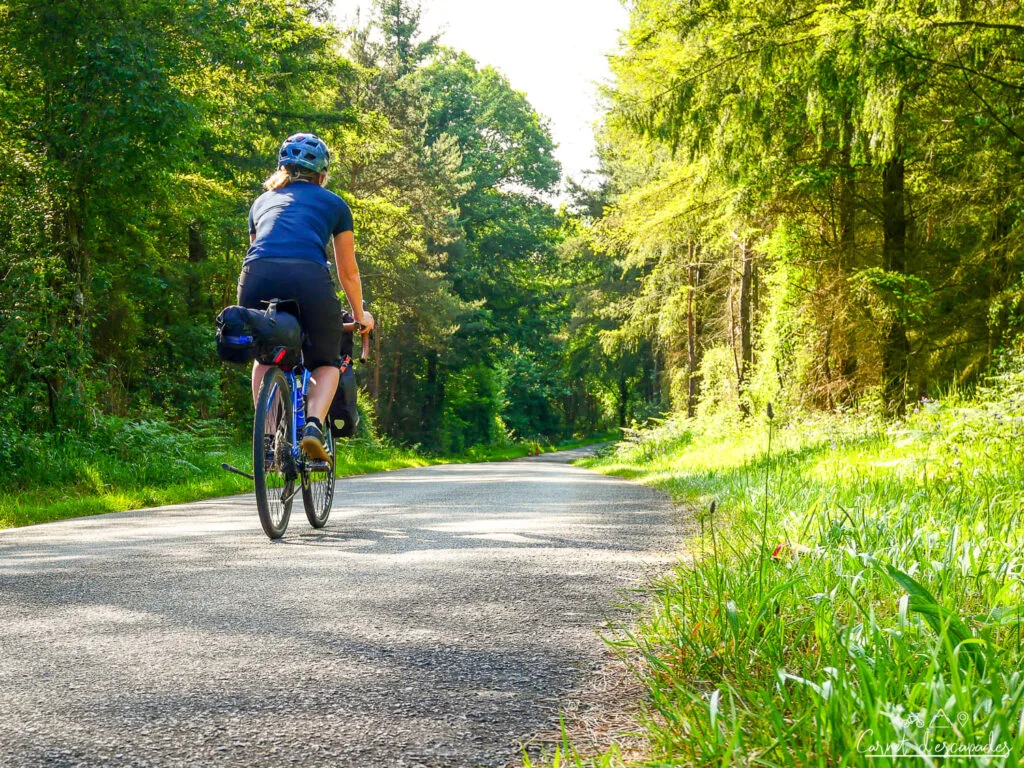
On my first trips, such as the Alsace Wine Route, I cycled around thirty kilometers a day, and I remember that was more than enough for me! A few years later, when Icycled the Elbe, I covered an average of 80km a day.
As I said, it’s a matter of adapting to the criteria listed above, but I generally find that around 60km per day on average (3/4h of cycling at an average of 15km/h, which is reasonable for a loaded trekking bike) often offers a good balance between cycling and time for breaks/sightseeing and enjoying the places you pass through without suffering physical fatigue. That’s what I did on the Vélodyssée and Munich-Venice, and found it very comfortable.
If you’re looking to cycle as a tourist, I think it’s best to reduce the overall itinerary a little, so as to enjoy each place: in cycle tourism, there’s tourism 😉 And even if it’s impossible to try to do and see everything on an itinerary, I like to enjoy the places where I stop simply by strolling around. I see it as a good first approach to the places I’ve visited, which makes me want to come back to certain places to really explore them… And totally discourages me from returning to others!
But a more sporty approach is also very good: that’s the advantage of cycling, everyone can adapt to their own level and desires, there’s no right or wrong option 🙂 Just one watchword: ENJOY!